
Russian-American Cultural Center and the Harriman Institute Present an exhibition curated by Regina Khidekel
The Last Avant-Garde:
Kotlyarov-Tolsty’s Vivrism in Mail Art and Letters
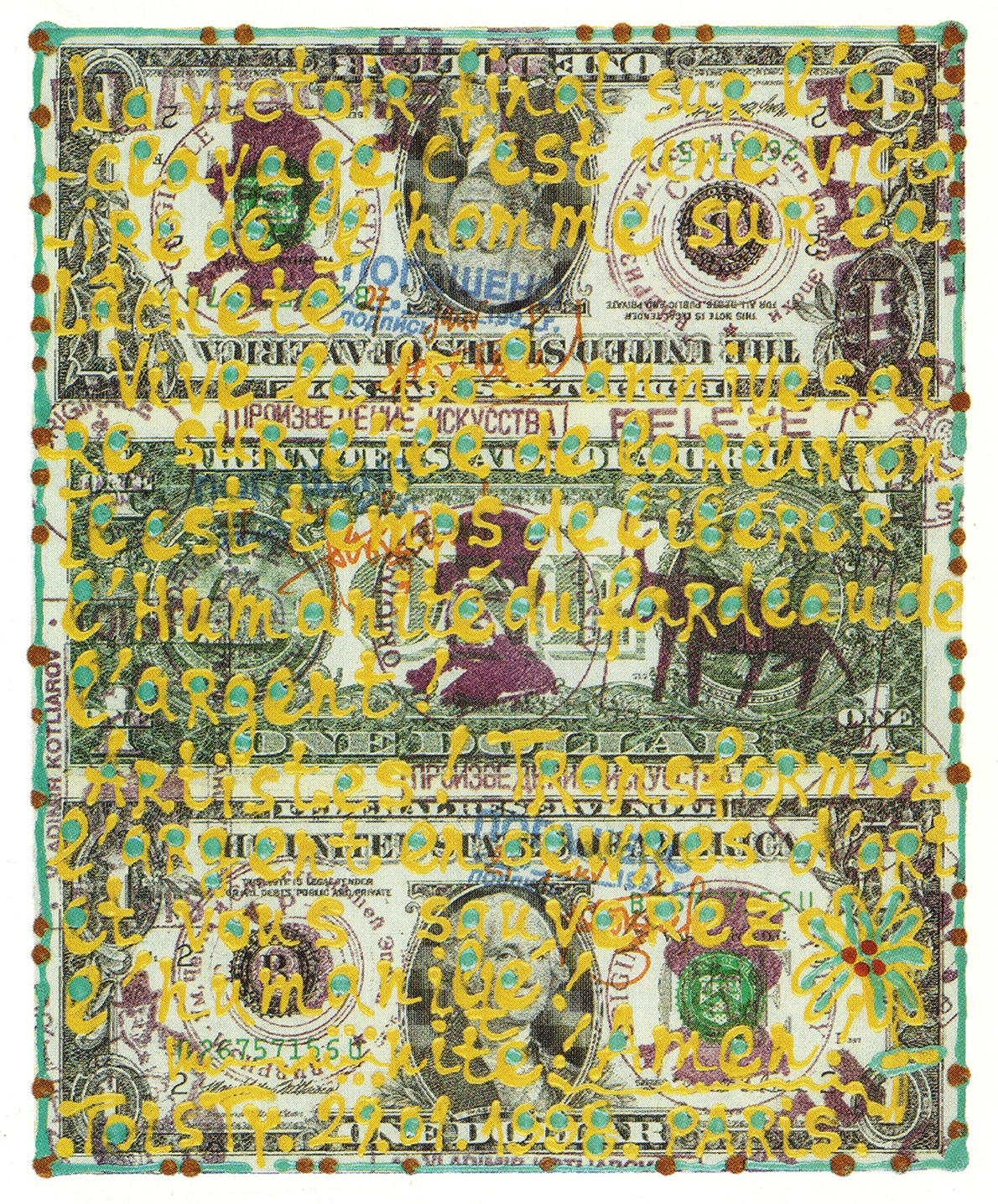
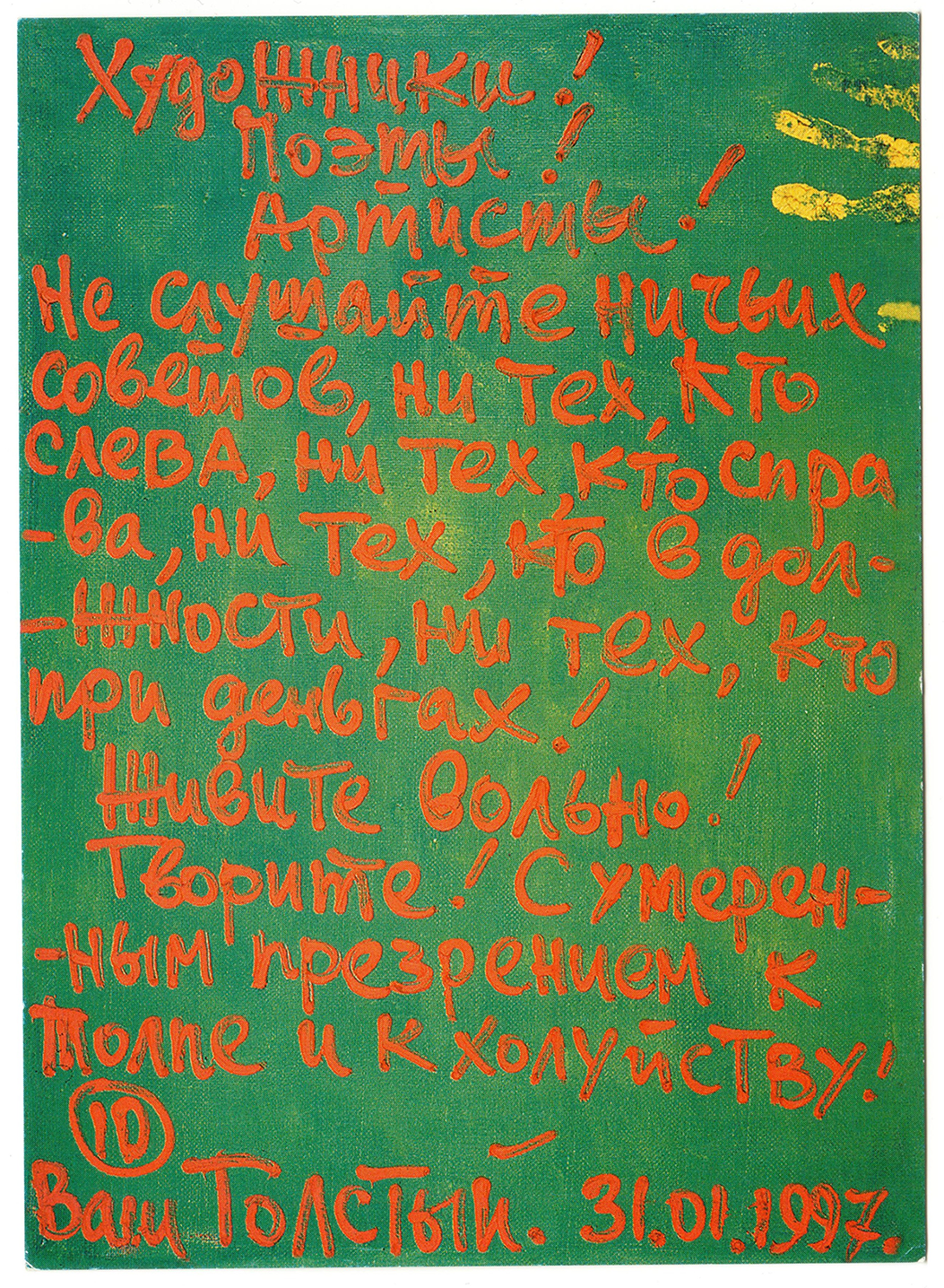
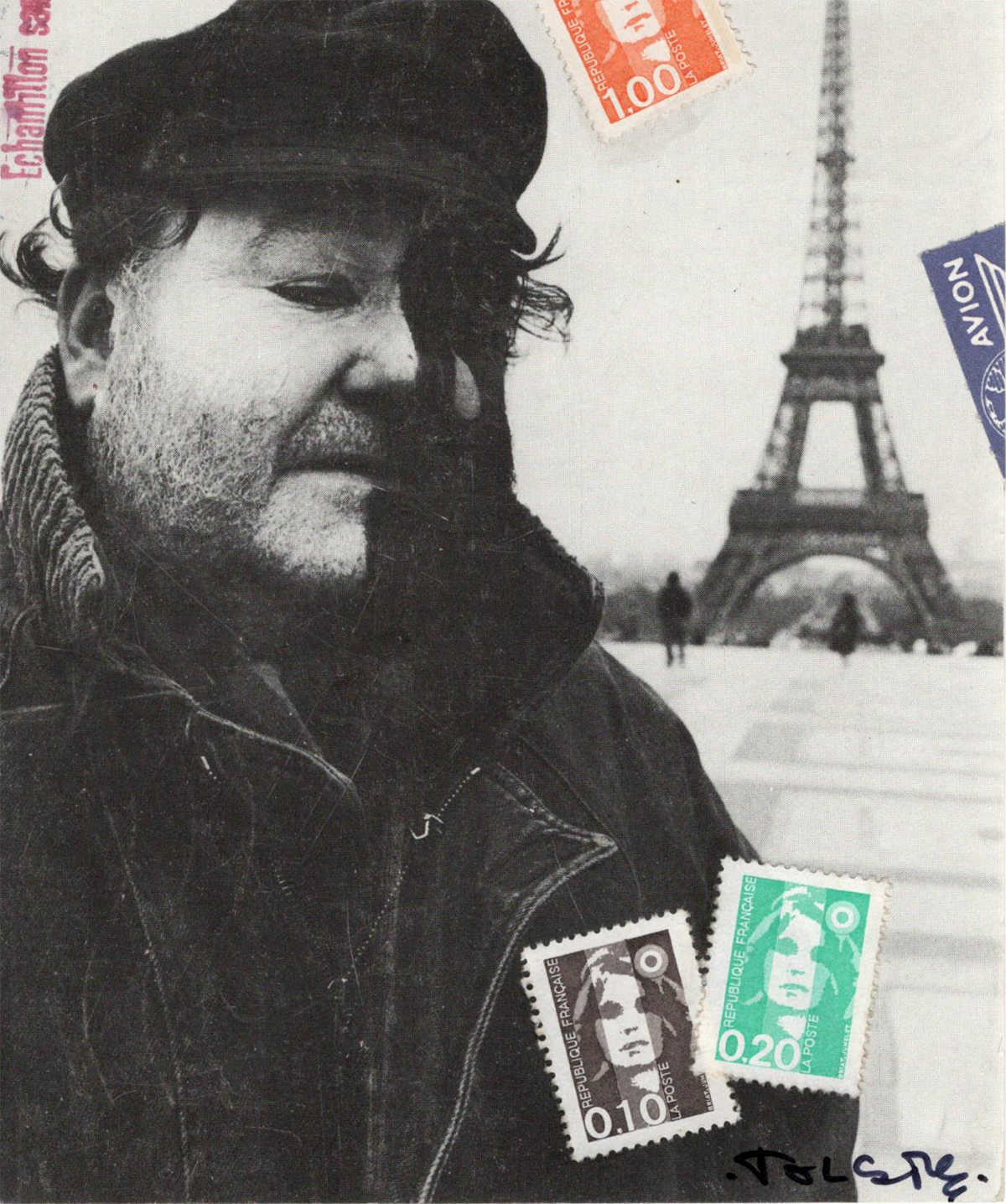
Mail art – a movement that embraced sending small-scale works through the postal service – was pioneered in the 1950s by the American artist Ray Johnson and was later embraced by artists associated with Fluxus and other experimental networks. Many of these rebellious artists were dissatisfied with other modernist movements that too readily allowed themselves to be absorbed into museums and the commercial art market. They sought a new form of presentation for their art that was noncollectible and noncommercial – using the postal system as a decentralized gallery and a means of communication and exchange. Mail art held particular appeal for international dissident communities, especially for Russian émigré artists in the 1980s. For them, it was a novel form of avant-garde art that truly returned them to their roots. They were animated by something akin to Kazimir Malevich’s conviction that art ought to be “an activity free from all economic, practical, and religious ideologies.”
Vladimir Kotlyarov (1937–2013), known as Tolsty, became a prominent figure in the Paris émigré art scene after leaving the USSR for France in 1979. Trained in art history at Lomonosov Moscow State University (MGU), he was a poet and experimental artist who also worked as a television presenter, restorer, and actor. His radical views and seething emotional energy inclined him towards anarchism, and he became known for his extravagant public gestures. When he left the USSR, he installed a cenotaph in his family’s memorial niche at Moscow’s Novo Donskom Cemetery, inscribed with his name and the dates “1937 – 1979.”
In France, Tolsty initiated a flurry of activity and quickly established himself as a prolific and provocative figure. He founded the artistic movement ‘vivrism,’ from the French vivre, “to live.” The principles of vivrism took shape in his mail art, in his so-called visuances – a form striving to expand beyond performance art, derived from the French séance visuelle, or “visual session” – and in the periodicals he edited and published. One of his best-known visuances occurred in Rome in early May 1981. Naked and painted, Tolsty entered the Trevi Fountain and shouted in six languages, “Italians, protect the pope!” Nine days later, a would-be assassin, Mehmet Ali Ağca, shot and wounded Pope John Paul II. The unexpected confluence of events became part of the action’s subsequent legend.
Publications associated with Tolsty – the literary and artistic almanac Muleta and the newspaper Evening Bell – drew radical and rebellious writers from Parisian bohemia and international émigré circles, among them Eduard Limonov, Konstantin Kuzminsky, Alexei Khvostenko, Vladimir Maramzin, Mikhail Grobman, Vagrich Bakhchanyan, and others. The bold iconoclasm of Muleta alienated parts of the émigré community, especially the journal Kontinent – derisively known for its ‘Soviet-anti-Soviet’ language. Andrei Sinyavsky’s Sintaksis was more sympathetic, and its editor-in-chief Maria Rozanova saw Muleta as a representation of the Russian avant-garde in a Parisian shell. A provocateur and anarchist, Tolsty chose the title Muleta to evoke the extreme struggle between life and death. A muleta is the small red cape used by a matador in the final stage of a bullfight, when the matador approaches the bull to deliver the fatal blow.
In Paris, Tolsty also founded a half-mocking Russian anarchist group whose name, Black Repartition of Land and Liberty, is a composite of two nineteenth-century revolutionary organizations. In its theoretical program, he proposed supplementing the classical triad “Liberty. Equality. Fraternity.” with a second: “Mutual Aid. Enlightenment. Honor.”
Tolsty’s vivrism also had a pedagogical dimension: in postcards and published texts, he advised artists on how they should conduct themselves in public and within artistic communities. Vivrism held that art and life were one and the same, and that an artist’s creative practice and everyday existence should merge – no matter the genre – in a kind of artistic self-immolation. Tolsty’s vivrist mail art exemplified this principle through intense collage and abrupt juxtaposition. His body-based visuances and projects such as The Inner Life of an Artist, made from X-rays of his body, likewise turned his physical ontology into artistic material. His pseudonym, Tolsty – Russian for “fat” – defined his identity as both object and subject of his art. This approach was especially prominent in his collaborations with Mitki – the Leningrad nonconformist group whose art similarly transformed their collective personality and lifestyle into an aesthetic program. The group took its name from its central figure, Mitya Shagin.
The Last Avant-Garde: Kotlyarov-Tolsty’s Vivrism in Mail Art and Letters exhibition will feature mail art by Kotlyarov-Tolsty, letters written as artistic artifacts, posters, and photographs documenting his visuances and other shows. Highlights of the collection include the Fourteenth Vivrist Manifesto, dedicated to Regina Khidekel and sent from Paris to Leningrad in early 1991; Vagrich Bakhchanyan’s “postal art in exile” and his mail-art exchange with Rimma Gerlovina and Valeriy Gerlovin in New York; and collaborative work with Mitki in Paris and Leningrad. The collection will also include a historically significant envelope and letter, dated March 24, 2003, from Kotlyarov-Tolsty to Elena Shchapova, Limonov’s first wife. The letter seeks financial support for Limonov’s legal defense after he was imprisoned in Moscow in connection with his activity with the National Bolshevik Party (Nazbol), which he co-founded. Among the papers is a copy of a check deposited at the infamous Menatep Bank into the account of Dmitry Alekseevich Rakitin, a longtime friend and confidant of Limonov from his years abroad. Together, these documents preserve the material record of an émigré literary network mobilized around a political prosecution.
Drawn from the private collections of Regina Khidekel, Lyudmila Kotlyarova, Elena Shchapova-Karli, Maxim Kravchinsky, and others, the works on display document the history of a late effort to sustain an avant-garde movement within a milieu of dissident and émigré artists.
An exhibit opening reception will take place on October 27, 2026 at 6:00pm. Learn More >>
Hours
Monday–Friday, 9:00 AM–5:00 PM
October 26 through December 16, 2026
Location
Harriman Institute Atrium
420 W 118th St, 12th Floor
New York, NY 10027
Visitor Information
Registration and government ID are required to visit the exhibit. Please email harriman@columbia.edu no later than 48 hrs before entry to register.
