
This event has been postponed.
Location Note
1219 International Affairs Building
420 W 118th St, 12th floor
This event is in-person for CUID card holders only. In-person attendees must be in compliance with Columbia University’s health protocols for returning to campus. Pre-registration, valid CUID card, valid green pass, and face covering are required for admittance. All other attendees may participate virtually on Zoom or YouTube.
Please join the Harriman Institute for a discussion with David Wolff (Hokkaido University) on the early history of the Russian Institute and the Rockefeller Foundation’s impact on global Slavic Studies. David C. Engerman (Yale University) will serve as discussant, with Valentina Izmirlieva, Director of the Harriman Institute, as moderator.
It is well known that the Harriman Institute’s predecessor, the Russian Institute, established in 1946, was the first area studies center in the United States devoted to multidisciplinary teaching of and research on Russia. David Engerman’s path-breaking monograph Know Your Enemy relates the focused philanthropy with which the Rockefeller Foundation began to support area studies in the 1930s, encouraged innovations during World War II, and finally poured over a million dollars into the Columbia project, making it preeminent.
What is less well known is that the Rockefeller Foundation was not only interested in establishing area studies in the US for patriotic purposes, but also made grants in the late 1940s and 1950s to set up or strengthen area studies centers all over the “free world” in order to provide cross-cutting knowledge to policy communities everywhere in the hope that better information would lead to better international relations. These connections radiating from New York can be construed as an additional Cold War front. In this project, Slavic Studies would have a special place, and Columbia, the flagship of American Slavic studies, would serve as both model for and host to leading scholars with leading roles at their home institutions. This research makes use of Rockefeller Foundation and Columbia University archives, as well as memoir materials from Japan and Germany.
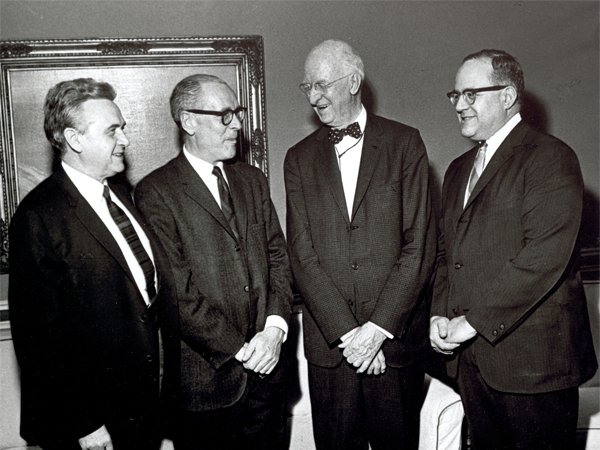
Featured image: Left to right, Philip Mosely, Henry Roberts, Geroid Robertson, Alexander Dallin.
Biographies
 David Wolff (AB Harvard, ’81; PhD Berkeley, ’91) is director emeritus of the Cold War International History Project at the Woodrow Wilson Center and a former Council on Foreign Relations International Affairs Fellow (Japan). In 2006, he was appointed Professor of Eurasian History at the Slavic Research Center, Japan’s national research center for the post-Soviet space. He has been a visiting professor at Harvard, Berkeley and the University of Chicago. He is the author of To the Harbin Station: The Liberal Alternative in Russian Manchuria, 1898-1914 (Stanford, 1999; Kodansha, 2014) and Le KGB et les pays baltes (with Gael Moullec) (Belin, 2005). He has coedited several seminal trans-Pacific collections including: Rediscovering Russia in Asia (with Stephen Kotkin), World War Zero: The Russo-Japanese War in Global Perspective (with Steinberg, Marks, Menning, Schimmelpenninck and Yokote) and most recently Russia’s Great War and Revolution in the Far East (with Yokote and Sunderland). He is presently completing a volume of Russian and Japanese documentation on the transit of the Soviet Union by Sugihara survivors in 1940-41 and a monograph on Stalin’s postwar Far Eastern policy.
 David C. Engerman is the Leitner International Interdisciplinary Professor of History at Yale University. Building on his dual training in American and Russian/Soviet history at the University of California-Berkeley (where he received his Ph.D. in 1998), he wrote two books on the place of Russia and the USSR in American intellectual and political life: Modernization from the Other Shore: American Intellectuals and the Romance of Russian Development (Harvard UP, 2003) and Know Your Enemy: The Rise and Fall of America’s Soviet Experts (Oxford UP, 2009). He has also researched and written on a variety of topics related to the history of development assistance, including a co-edited volume, Staging Growth: Modernization, Development and the Global Cold War (U-Mass Press, 2003), and most recently a monograph, The Price of Aid: The Economic Cold War in India (Harvard UP, 2018). His new research focuses on the geopolitics of international economic inequality in the second half of the twentieth century.
