
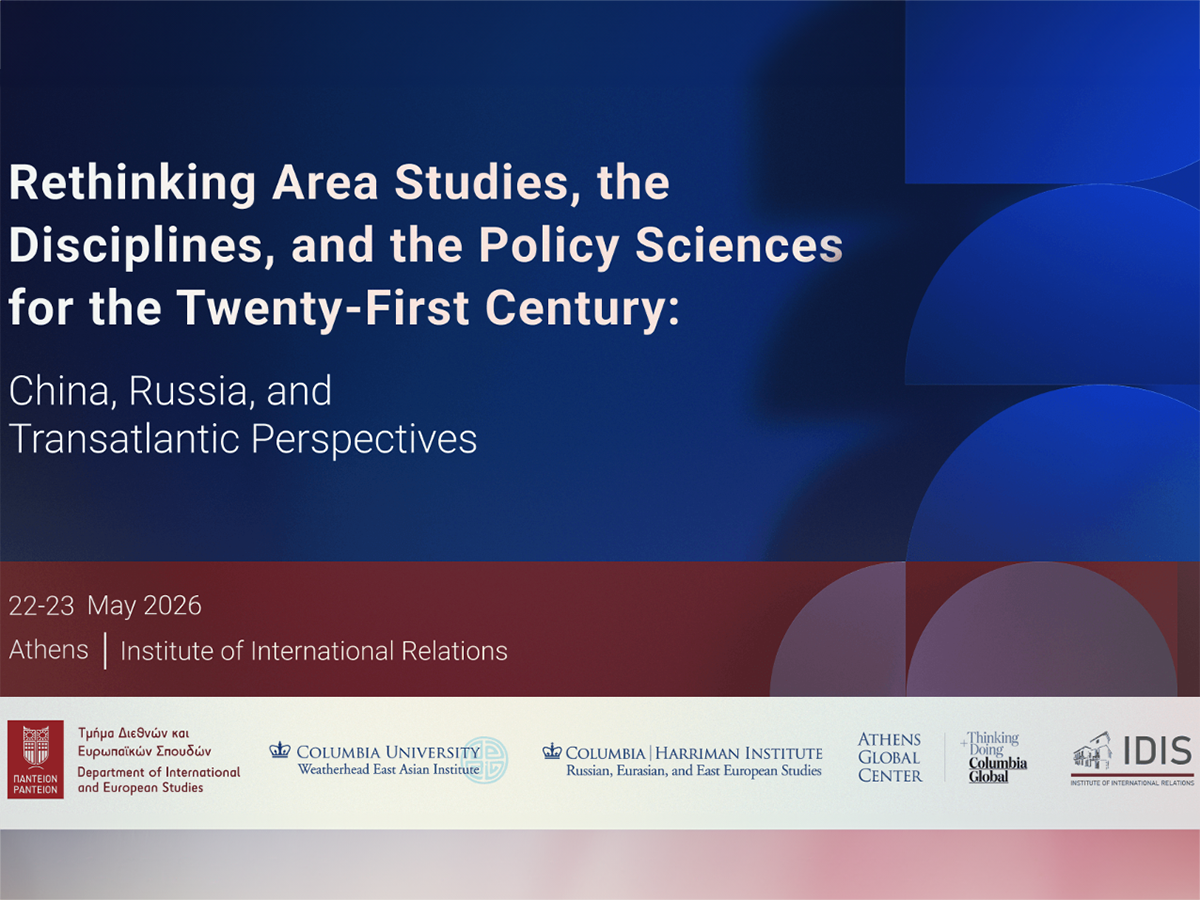
Please join the Panteion University of Social and Political Sciences, the Institute of International Relations, the Weatherhead East Asian Institute, the Harriman Institute, and the Athens Global Center for the conference Rethinking Area Studies, the Disciplines, and the Policy Sciences for the 21st Century: China, Russia, and Transatlantic Perspectives.
In an era marked by geopolitical rivalry, technological disruption, economic fragmentation, and heightened global uncertainty, the need for deep, context-sensitive knowledge of regions and societies has never been greater. Yet area studies today in Europe and the US face renewed questions about their intellectual form, institutional location, and relevance within increasingly abstract disciplinary frameworks and more results-driven policy-science approaches. Focusing on China and Russia as countries of concern — and drawing on the expertise of Panteion’s Department of European and International Studies, Columbia’s Weatherhead East Asian Institute and Harriman Institute and of colleagues from European academic and policy institutions — this Columbia-Panteion conference brings together area specialists, disciplinary scholars, and policy analysts to examine how Greece/Europe and the United States understand, analyze, and respond to the challenges these actors pose to the contemporary world system. Anchored in the growing partnership between Panteion University and Columbia University, including the forthcoming Master’s Degree linking the M.Sc. in Global China and the M.A. in Regional Studies: East Asia, the conference positions this collaboration as a laboratory for rethinking the roles of area studies, the disciplines, and the policy sciences for the twenty-first century.
Conference Program
Day 1 (May 22): Understanding Power, Risk, and Difference: China and Russia in a Changing Order
9:30 – 10:30am | Conference Welcome and Introductory Remarks on the Columbia-Panteion Collaboration
Overview of the Columbia-Panteion Dual Degree as a reference point, its origins and purpose to combine deep area knowledge with analytical and policy skills; how graduate programs can prepare students to work on China and Russia-related global challenges; conference origins and purpose.
Welcome and Opening Remarks by:
- Kostas A. Lavdas (Panteion)
- Stathis Gourgouris (Columbia)
- Alexander Cooley (Columbia – Harriman)
- Sarah Jessup (Columbia – Weatherhead)
- Stefanos Gandolfo (Columbia – Athens Global Center)
- Andreas Gofas (Panteion)
10:30am – 12:00pm | Session I: What Kind of Knowledge Serves Greece’s Interests in Dealing with Russia and China?
Greece’s position in the international system and relations with Russia and China. Reflections on the historical aspects, current situation and relevant knowledge and infrastructure in the country.
Chair: Constantine Arvanitopoulos
- Kostas A. Lavdas
- Vassillos Paipais
- Harry Papasotiriou
1:00 – 2:00pm | Session II: Transatlantic Ways of Knowing: How Europe and the United States Study China and Russia
This session explores how American and European academic traditions have approached the study of China and Russia differently, in terms of disciplinary organization, methodological priorities, and proximity to policy communities. It asks how these differences shape what is seen as analytically relevant, which questions are asked, what blind spots are created and how and what kind of knowledge travels across the Atlantic.
Chair: Phillippe Peycam
- Peter Gries
- Eugenia Lean
- Alexandra Vacroux
2:15 – 3:00pm | Session III: How to Teach Human Rights?: The Roles of Area Studies, the Disciplines, and Policy Sciences
What should we teach students who intend to work on human rights issues in authoritarian societies?
Chair: Alexander Cooley
- Andrew J. Nathan
- Jack Snyder
3:00 – 4:30pm | Session IV: Revisionism and Reframing: How China and Russia Read the International Order They Challenge
This session explores how Chinese and Russian elites and media interpret and present the international order they contest, and how these interpretations compare with Western analytical frameworks. It examines the elite beliefs, media institutions and information strategies each side deploys to shape narratives about global order and Western policies, from Chinese outlets such as Xinhua, CGTN, and Global Times to Russian outlets such as RT and Sputnik. The panel assesses how these competing readings and changing global media landscape shape revisionist behavior, with implications for strategic misperception, escalation, and global stability.
Chair: Kostas A. Lavdas
- Thomas Christensen
- Alexander Cooley
- Natalia Moen-Larsen
- Zoe Zongyuan Liu
- Dimitrios Triantafyllou
Day 2 (May 23): Rethinking Area Studies and Graduate Training: From Diagnosis to Design
10:00 – 11:15am | Session V: Is the Policy-Area Studies Nexus Broken?
In light of the cuts of the federal government to the policy and think tank world. Is the nexus between area expertise and policy relevance in the US permanently severed? And how does this new situation in the US affect the global university landscape?
Chair: Jack Snyder
- Kristin Fabbe
- Michael Kimmage
- Eugenia Lean
- Lü Xiaobo
11:45am – 1:00pm | Session VI: What Should “New Area Studies” Look Like?
Rather than revisiting familiar debates about the decline or return of area studies, this session treats China and Russia as empirical test cases for rethinking how area-based knowledge should be organized today. It explores problem-driven approaches, methodological pluralism, the role of language and new forms of integration with disciplinary and policy-oriented research.
Chair: Eugenia Lean
- Elise Giuliano
- Philippe Peycam
- Michael Vatikiotis
- Lü Xiaobo
- Zoe Zongyuan Lu
2:00 – 3:00pm | Session VII: Designing Graduate Training for Global Risk
This session examines area studies in graduate training, with a focus on equipping students with the analytical, and policy-relevant skills needed to navigate an era of global risk shaped by geopolitical competition, technological change, and systemic uncertainty.
Chair: Elise Giuliano
- Stefanos Gandolfo
- Tinatin Japaridze
- Konstantinos Tsimonis
3:15 – 4:30pm | Session VIII Roundtable: Employability, Expertise, and Professional Pathways
This session brings employers and practitioners into direct conversation with faculty about the professional trajectories of graduates trained in area studies, international affairs, and global risk analysis. Rather than focusing on generic “skills,” the discussion centers on how employers evaluate expertise on China and Russia, how they distinguish depth from surface-level competence, and what kinds of training genuinely enhance graduates’ employability in risk-related fields.
Chair: Sarah Jessup
- Margarita Dimova
- Aris Iliopoulos
- Ilya Roubanis
- Alexandra Vacroux
- Zoe Zongyuan Liu
4:30 – 5:15pm | Session IX Closing Remarks: How to Promote China and Russia Expertise in the 21st Century
- Thomas Christensen
- Alexander Cooley
