
What region/topics are you focusing on at the Harriman Institute/SIPA?
I’m interested in the successes and limitations of U.S.-targeted, “smart” sanctions against a range of actors that pose similar threats to regional security and stability, including Russian entities and elite figures as well as those in other former Soviet countries, such as Georgia. Moreover, I’m exploring the increasingly ambitious Russian utilization of hybrid warfare in former Soviet and Warsaw Pact countries, as well as the Western Balkans, particularly as the Russian security apparatus engages in a nexus with organized crime across these spaces.
What is your thesis about (if applicable)?
I am not pursuing a thesis. However, I am incorporating much of what I learned from past and present Harriman courses into my research for my SIPA Capstone group project with The Sentry, which focuses on the present nature and future prevalence of kleptocracy. My individual research case studies are Uzbekistan 1991-2016 and Albania 1992-1997.
What are some of your favorite things about studying here?
The Harriman Institute faculty are incredible. Every lecture I have attended has incisively probed into key concepts and practical issues in such detail that I leave the International Affairs Building every day with my knowledge vastly expanded. Relatedly, the discussions fostered in and out of the classroom with Harriman students and faculty are highly multidimensional, bringing to the table key perspectives on urgent topics that encompass culture, security, politics, environment, economy, history, and so much more.
What’s your most memorable experience here so far?
As a Program Assistant with the Harriman Institute, I helped with the October 11, 2025 conference, Revolutionary Yugoslavia: Partisan Art, Archives and Film. During my undergraduate studies I had developed a deep academic concentration in the security and political dynamics across the Western Balkan region, but this conference radically and rapidly opened my perspective to encompass the region’s cultural traditions and practices with roots from the Yugoslav era. Also, I had the privilege of meeting Dr. Vladimir Kulić, whose curation of an exhibition at the MoMA had previously influenced my understanding of architecture and the overall intersection between message and functionality in the design of space.
Where in the region have you traveled?
As a teenager, I travelled to many of the former Warsaw Pact states, and in my childhood, I had the opportunity to travel to the Russian Federation. In addition, before my undergraduate studies, I visited Bosnia and Herzegovina (twice), Croatia, and Montenegro. In the future, I would very much like to travel to the Caucasus region, especially Georgia, after having taken Dr. Julie George’s Politics of the Caucasus, in addition to Albania and North Macedonia.
Fun fact about you:
When I was 12, I learned to fly a Cessna 172 single-engine aircraft, and until I was 17, I spent my summers training for a private pilot’s license! I’m looking forward to someday continuing my training and getting qualified for turbine helicopters, mainly the Bell 205 airframe.
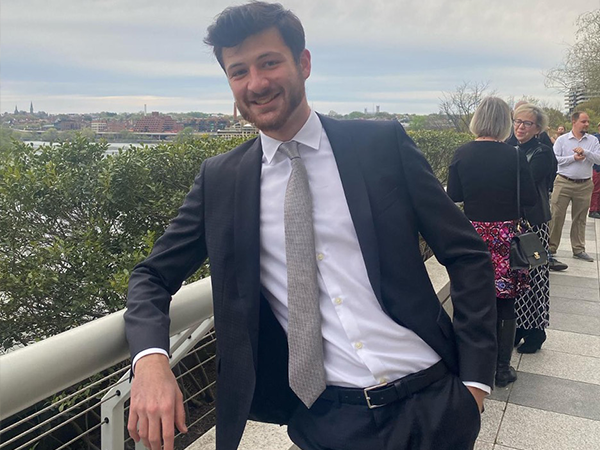
Pictured: Ian Kearns at a ballet rendition of Leo Tolstoy’s Anna Karenina in 2023.
