
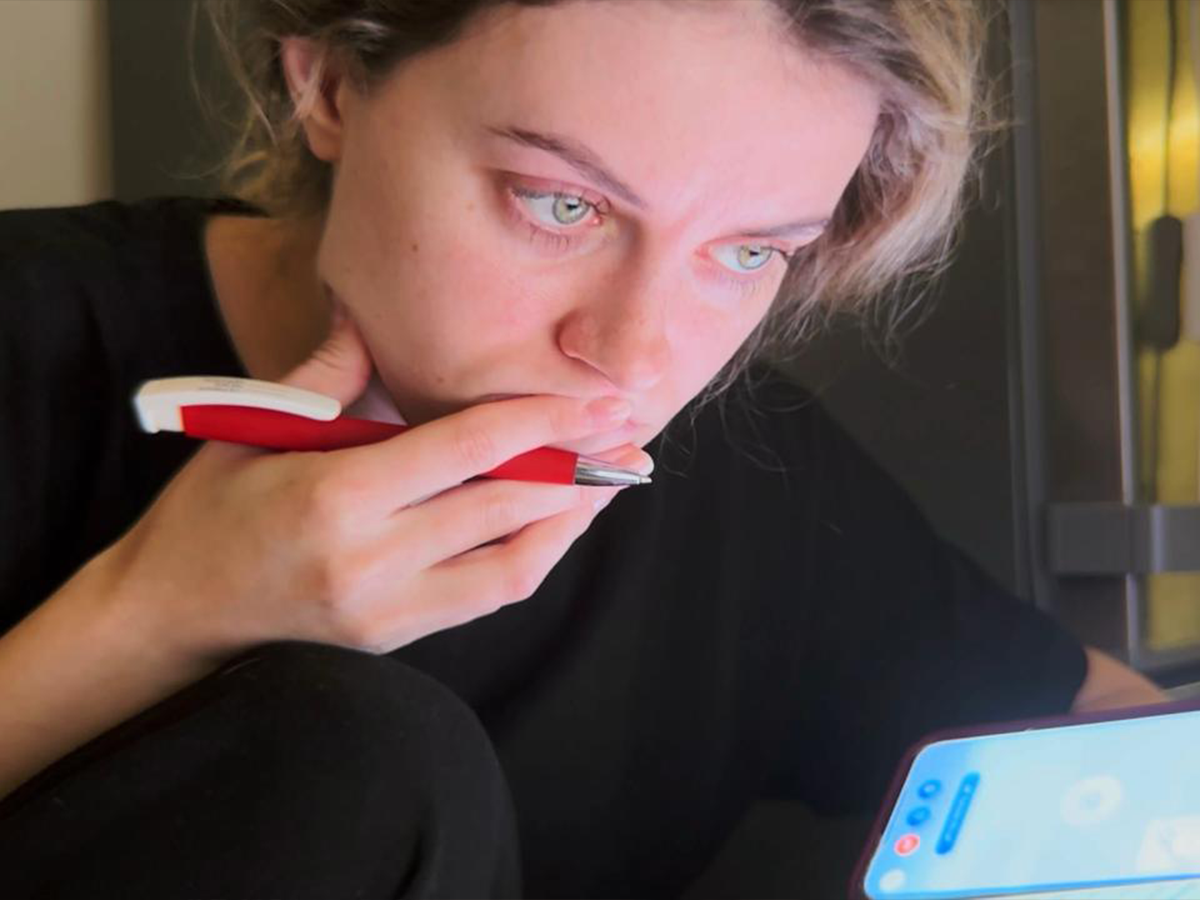
This is part two of a two-part interview with the Harriman Institute’s Paul Klebnikov Civil Society Fellow Irina Dolinina. Dolinina is an investigative reporter with Important Stories, a Russian independent investigative outlet in exile. She is a main character in Julia Loktev’s award-winning documentary, “My Undesirable Friends Part I – Last Air in Moscow” and the forthcoming “My Undesirable Friends: Part II — Exile.” I interviewed Dolinina at the Harriman Institute on April 13, 2026. Much of this portion of the interview was conducted in Russian and translated. The translated transcript has been edited and condensed for clarity.
[In Part I, which covers Dolinina’s life and career in Russia before she went into exile following Russia’s full-scale invasion of Ukraine, we left off with Dolinina realizing she had to leave Russia.]
Udensiva-Brenner: Where did you go?
Dolinina: First we crossed the border by foot because of our dogs. Alesya [Marokhovskaya, Editor-in-Chief of iStories], me, and another one of my colleagues, we all had dogs and I couldn’t let my dog be on a plane because it’s dangerous — a lot of dogs have died being transported in the baggage area. And my dog, I rescued her from a shelter, and she was really sick. So I couldn’t risk her life.
We put our three dogs in one taxi and arrived at the Latvian border, then waited many long hours in the cold with a lot Ukrainians who were also waiting to cross.
So, that first week I was in Riga and then Roman [Anin, founder of iStories] took us by car to Prague.
Udensiva-Brenner: So you never went to Tbilisi?
Dolinina: No, I couldn’t because Roman forbade us. Georgia is on the border with Russia and that worried him. Roman had prepared European documents for us before the big war. He wasn’t as delusional as we had been.
Udensiva-Brenner: And so, you went to Prague and you’ve been there ever since. In our pre-interview conversation, you mentioned that you started studying Ukrainian. Can you talk about that and the reporting you were doing when the big war started?
Dolinina: In the first months [of the full-scale war], I went to the border of Poland and Ukraine and interviewed Ukrainian refugees. I wasn’t comfortable asking them to speak with me in Russian. And also, some of them refused. It’s such a gift for a Russian journalist to be able to speak with a Ukrainian. You should be so grateful. So, I started to learn Ukrainian.
I was reading the literature. And I was so impressed by this desire for freedom and rebellious spirit that was described in Ukrainian literature even in the 19th century. And I was reading poetry and listening to a lot of Ukrainian music. And I was able to read the comments on social media in Ukrainian and [came to] to understand how to write about this war without making the stupid mistakes that Russians often make. Some things that we say, for example — I still make this mistake — we say “occupied territories,” but Ukrainians say “temporarily occupied territories.” And it’s important, you know? Because when you say “occupied territories,” there’s a finality to it.
My goal was to learn Ukrainian and then report from Ukraine. To try to get a visa. But [after the first month] they closed the border to Russian journalists, so right now it’s almost impossible.
Udensiva-Brenner: And what is the main focus of your reporting now?
Dolinina: It’s still the war. I’ve been participating in cross border collaborations [with Western media outlets] when some [high profile] Russians appear in leaks — my colleagues found some of their villas in [European] countries — or when Russians evade sanctions or open shadow companies. I do this work, but it’s always the second priority. Mainly I’m covering the consequences of the war for Russians. How are they living? What’s happening with the anti-war Russians in the country? I report a lot about the Russian Army.
Udensiva-Brenner: And how do you find sources?
Dolinina: When the big war started, a lot of professional Russian soldiers understood that they had been tricked. That they were participating in an invasion rather than protecting their country as they’d been told by their commanders. And they didn’t want to participate in that. They lost a lot of people in the first month. And a lot of them deserted from the Russian Army. And at that time, they were willing to speak with journalists.
Udensiva-Brenner: And did they flee the country?
Dolinina: Some of them, yes. Others stayed because they didn’t know any other languages and they preferred to hide within the country.
Udensiva-Brenner: They would reach out to you directly?
Dolinina: Some of them, yes. We got a lot of sources during the first month [of the full-scale invasion], when professional Russian soldiers told their commanders “We don’t want to participate in this war anymore.” We lost like half of our unit. We want to quit.” And they had a legal opportunity to quit but nobody wanted to let them go freely.
[Editor’s note: Technically, Article 59 of the Russian constitution guarantees the right to “conscientious objection,” allowing a soldier to replace active service with civilian service if a war conflicts with personal or religious beliefs. This right was rarely upheld even before the mobilization in September 2022.]
And they were tortured. They were imprisoned by their commanders. By other soldiers, Wagner soldiers. They were real hostages without food, water. They were under pressure. And some of them were killed. And that’s why they started contacting the media. First [they contacted] official media, but [the media] wouldn’t talk to them, and then they started contacting us [independent journalists]. And I remember one conversation, a soldier told me, “I would have never believed that I would speak with a foreign agent. I hated you. I was being told by television that you are the enemy. But you are the only one who is listening to me right now. You are the only one who is writing about what’s happening with us.” That’s how I was able to develop some sources.
Udensiva-Brenner: Can you tell me about life in exile? What is it like living in Prague?
Dolinina: I don’t feel safe. Back in [March] 2023, we started receiving threatening emails through the iStories online contact form. They said they knew Alesya’s [Marokhovskaya, Editor-in-Chief of iStories] address in Prague, that they knew mine, and that if we continued writing our articles we wouldn’t sleep well because they would come for us. Then they disappeared for a while, but we knew this was serious because we had never publicized our address, never threw parties. We have a certain security protocol and we took it seriously. The letters stopped for a while. And then [in September 2023] Alesya and I were supposed to fly to the Global Investigative Journalism Conference in Switzerland, they have this huge conference every two years, and we’d already purchased tickets and reserved the hotel. And then we received [an anonymous email] with our travel itinerary, even our reserved seats on the airplane, basically saying, “we know everything.”
Udensiva-Brenner: That’s terrifying. Did you go to the conference?
Dolinina: No, we canceled it because we didn’t want to put the other participants at risk. Because when a Russian agency conducts some sort of operation, the people around suffer too …
Udensiva-Brenner: And did you move apartments?
Dolinina: Yes, Alesya moved first and they sent another email to the iStories account [in August 2023] saying something like, “You can’t hide from us. We know your scum fled like a terrified rat. We will find her wherever she walks with her wheezing dog. There is nowhere for her to hide.” Her [Alesya’s] dog has breathing problems and you have to be a meter or two away to hear this. They included this detail so she knew that they were nearby.
Honestly, Prague is so small, it’s so easy to find people there. And before we started receiving the threats, I noticed people following me in various places but I thought it was just paranoia left over from being in Russia. I thought I was making things up. But then it turned out I wasn’t. And I still notice people following me. Sometimes you’re walking around and you’re walking straight and you notice someone else walking straight behind you, so you find little ways of checking. You start deliberately making strange turns, and if they follow you … well, that’s the first sign. I even have photos. I have this really creepy shot—I’ve never posted it anywhere — [this guy] tried to hide behind a lamppost. He’s just standing there, but you can’t really hide all that well behind a lamppost. And that’s exactly how the photo turned out. Half a face behind a lamppost.
For a while we didn’t write about [the stalking, the threats], didn’t make it public, because it felt trite to complain about threatening emails when Ukrainians had to live under constant explosions and threats to their lives. We didn’t want to put the spotlight on ourselves. We waited about six months, but then after they sent our flight itinerary and it felt so out of control, we published an article about it. We also went to the Czech police.
At one point, it was taking too long to find another apartment and they [iStories] were concerned about my safety and moved me temporarily to Berlin.
Udensiva-Brenner: How long were you there?
Dolinina: I was there for three months. Sadly, I can’t really say it’s much safer there.
Udensiva-Brenner: Have there been similar cases with journalists there?
Dolinina: No, not like ours, but there was the situation with Lena’s poisoning. She was living in Berlin [Elena Kostyuchenko was a 2018 PKF Fellow. Read a profile of her in “Harriman Magazine” and about the poisoning attempt.”]
Also, I had a friend who turned out not to be so well-intentioned. You probably read about it.
Udensiva-Brenner: What happened?
Dolinina: I published an article about my friend Maria Chashchilova [“I Admit that I Deceived You,” Jan 2025, iStories]. I think this is what hit me the hardest. Because she’d asked me for so much information. “Do you have anyone left in Russia? And what’s your legal status in Europe? And how do they send you [iStories] donation, crypto or something else? And where do you live?” And some of these things I stupidly answered because I trusted her.
Udensiva-Brenner: How did you meet her?
Dolinina: She approached me. In 2021 when I first became a foreign agent. We were taken to Armenia for a safety training. There were 20 or 30 people and they asked us, “Do we have any foreign agents here?” And at that point there were only 20 of us [foreign agents in Russia] and I raised my hand. I was the only foreign agent there. She came up to me and told me that she’s a lawyer and she could help me. Spoiler: she’s not a lawyer. She doesn’t have a law degree. She doesn’t have a legal education. It was all lies. But I didn’t know that. Of course, I’m an investigative journalist, I could have checked, but when you meet people in places like that, and it seems like everyone knows each other, and she’s endlessly name-dropping — “I worked here and there, I know this person and that person…” I told her, “I’m ok, I already have a lawyer,” but we started hanging out anyway.
They’re very good at this, the person starts “trauma dumping,” it’s called. She started telling me such tragic things about her life – some of them true some of them not – and so if you’re an empathetic person you develop this attachment: “Oh god, this person has such a difficult life. I have to support her. I have to be her friend.” And it happens in the snap of a finger. And then I was investigating her — I don’t wish this on anyone, having to investigate your friend — and I talked to other people and everyone had the same story. She looks for weak spots, who has what, and with me she made up a story about having a sick dog, because at that point I’d adopted a dog from a shelter who was very sick. Of course, she didn’t have a sick dog. Another person told her their dad had died, and then she tells stories about how her dad died… “social engineering,” it’s called. But I only found out later.
She’d asked for my address, both in Prague, and when I was in Berlin. And I’d given it to her. The first time, she’d messaged me, “Kitten, I have a gift for you, can you send me your address?” And so, I did. And I forgot about it. But later, after we’d received threats already, I realized she’d never sent me a gift. And then in Berlin, too – she knew I was going there for safety reasons – and the first day I arrived she messaged me and told me she wanted my address so she could come over and give me a hug. And I gave it to her, but then she never showed up.
Udensiva-Brenner: How do you cope with all this; how do you hold up psychologically?
Dolinina: Oy… at some point I started looking for a therapist in Prague. Started going to therapy. I found a psychiatrist and I started taking some pills. And also, in Europe there’s a big techno rave scene. I never listened to techno in Russia, but I discovered it in Europe and it’s really magical. I’m in survival mode so much of the time thinking about other people, and at a techno party you stand on the dance floor, put on your hood, your glasses, close your eyes, ask yourself a question and let the answer come to you. Techno is so rhythmic and it always goes somewhere, and for the first time you’re alone with yourself and music is an ideal way to give yourself that kind of therapy. So that’s been a big help.
Udensiva-Brenner: Is [life in exile] even scarier than when you lived in Moscow?
Dolinina: Maybe … year by year your psyche gets weaker and weaker. It was what, five years ago when Julia [Loktev] started shooting [“My Undesirable Friends”]? We were still in our mid-twenties. I went to cover the war without a bulletproof vest or anything. When you’re younger you apparently have less of a brain. Like they say, it’s still forming until you’re 25. But … in Moscow they raided Masha’s apartment [Maria Zholobova, 2019 PKF Fellow. See here for a “Harriman Magazine” profile and here for context on the raid] and then Roman’s [Anin of iStories] apartment, so we were always waiting for them to raid us … and it was hard to sleep, thinking they’d show up any moment, but at least we understood the protocol. They might be aggressive, they might have you lay on the floor, but you more or less know what will happen next, where they would take you. Maybe they’d even put you in jail. But in Moscow – at some point we all have this, Lena Kostyuchenko talked about this – there was this readiness to serve for the profession. Now I think we were misguided, because what can a journalist really accomplish from prison? We have an example of that that’s so tragic, I’ll start crying if I talk about it.
[Editor’s note: Dolinina is referring to the case of former defense reporter for Kommersant Ivan Safronnov.]
In Moscow we knew what to expect, but here [in Prague] they don’t have any administrative recourse, they’re not going to show up in a police uniform, break down your door and detain you … if they come to my apartment in Prague the story will be more like what happened to the Slovakian journalist.
[Editor’s note: Slovakian investigative journalist Ján Kuciak and his fiancee were murdered at their home in Slovakia in 2018.]
Udensiva-Brenner: And the Russian government [is considering] a new law that’s really bad for foreign agents, can you talk about that?
Dolinina: It’s a new law that includes a range of limitations for foreign agents, people who have criminal cases open against them, and just basically anyone they consider “enemies of the people.” So, what can’t we do [under this law]? We can no longer issue power of attorney, so my mom can’t forward any official letters to me, she can’t have access to my financial accounts. Also, we can’t sell any property, and if we get married abroad, the Russian Federation won’t recognize it. And, the most serious, we can’t renew our passports abroad. But anything can happen with a passport: it can expire, it can be stolen, damaged. But we can no longer get a passport outside of Russia. So, they’ve cut us off entirely … and, you’ll die hearing this … we can’t renounce our citizenship anymore, either. They’re such sadists!
[Editor’s Note: an earlier version of this interview misstated that this law had already been passed]
Udensiva-Brenner: And what do you hope to get out of your fellowship here?
Dolinina: Maybe it’s misguided, but I feel safe here, I don’t have nightmares that someone’s breaking into my apartment to kill me. So, a few weeks of safety. And also, connections with U.S. journalists. We have a lot to collaborate on. I have some expertise I want to share with colleagues here. Also, I think it’s really important not to be alone with your computer, not to be always on the phone with your sources. I can’t go to Russia to speak with my sources, I can’t go to Ukraine to speak with my sources. Sometimes it’s good to just feel the energy of my colleagues. Just so I have the strength to go on.
Pictured: Irina Dolinina calling a source. Still image from Julia Loktev’s film, “My Undesirable Friends: Part II — Exile.” The film will be out in the fall.
