
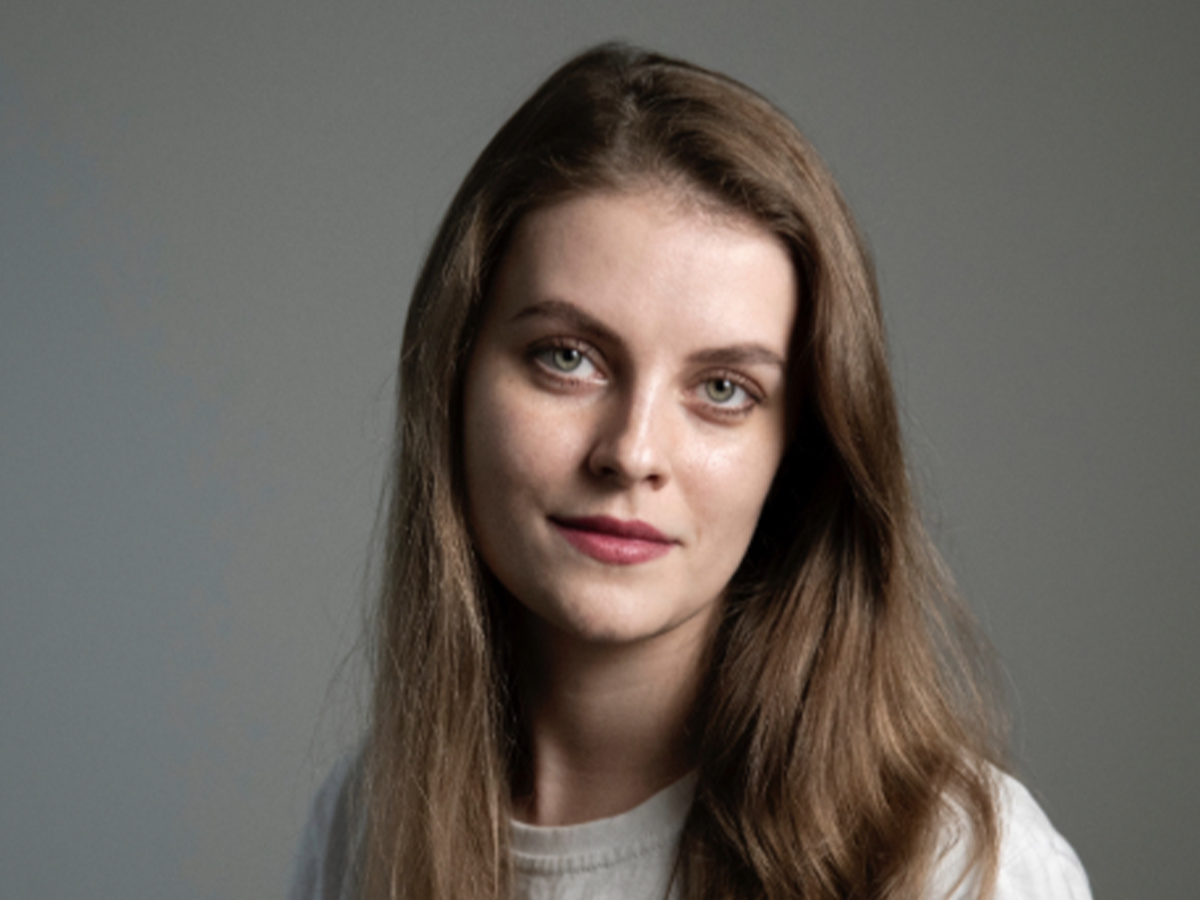
This is part one of a two-part interview with the Harriman Institute’s Paul Klebnikov Civil Society Fellow Irina Dolinina. Dolinina is an investigative reporter with Important Stories, a Russian independent investigative outlet in exile. She is a main character in Julia Loktev’s award-winning documentary, “My Undesirable Friends Part I – Last Air in Moscow” and the forthcoming “My Undesirable Friends: Part II — Exile.” I interviewed Dolinina at the Harriman Institute on April 13, 2026. The transcript has been edited and condensed for clarity.
Masha Udensiva-Brenner: Let’s start at the beginning. What’s your background and how did you get into journalism?
Irina Dolinina: I grew up in Nizhny Novgorod in the central part of Russia. In high school I worked for the school newspaper, and my editor told me, “you should apply to journalism school.” At the time I was also acting in a youth theater, and what I had wanted for most of my childhood was to be an actress and a director. But, the competition in Russian university acting programs was so high — thousands of people per spot —and I didn’t get into acting school the first year I applied. I really wanted to get out of Nizhny Novgorod and move to Moscow, which I had fallen in love with when I’d visited as a teenager, so I gave up on acting school and applied to journalism programs in Moscow.
I got scholarships from the Higher School of Economics (HSE) and Moscow State University (MGU). MGU was considered to be one of the top universities, but I was advised by my editor that if I wanted to be a real journalist, I should choose the Higher School of Economics because the program, which had opened a few years before [Dolinina enrolled in 2013], was not censored, not working for the government. And, even though all of my relatives were surprised that I turned down the chance to study at the more prestigious MGU, for me, it was a life-changing decision because at HSE they taught modern, independent multimedia journalism — a real journalist should know how to work with cameras, edit videos yourself, edit audio, everything.
There I got really into making documentaries. One film was about an electrician in the university dormitories, who was like a psychologist to all the students. Another film was about school children from a formerly “untouchable” caste in Nashik, India, where I participated in a volunteer program one summer.
Udensiva-Brenner: And then what happened?
Dolinina: [the late anti-corruption activist Alexey] Navalny and his team were making great documentaries about their investigations. And as students, we were analyzing these videos and I was so impressed. It was real progress to see investigative videos that weren’t boring. And they gained millions of views.
And then some of the producers of these investigations arrived at our university and taught us how to do it. And right around that time, I was having some ethical issues with making documentary films, because when you are shooting someone for hours and hours and then you decide how to edit it, it gives you so much control over how a person’s life is portrayed. And for me it was too much pressure. And then this investigative journalist came and showed us a world where you can work only with records. And you don’t need to decide which part of a person you will show and which part you will not show. Instead it’s, this record shows that this company is owned by this person. And so that’s how I became an investigative journalist.
Udensiva-Brenner: Considering that, how did it feel to be one of the main characters in a documentary?
Dolinina: It was really hard, and Julia [Loktev] knows, because we discussed it a lot. Sometimes I was really uncomfortable and I felt that I shouldn’t do it. As a journalist I felt like I shouldn’t be a character in a story. I was used to being behind the camera. But ultimately, it was good to be in front of a camera. I learned a lot about how you can feel when you are being filmed, which has been helpful in my own work.
Udensiva-Brenner: And were you happy with the final product?
Dolinina: Julia did a great job. She had hundreds and hundreds of hours and she chose some great moments. But also, watching it I had the thought that I hate myself. Why was I laughing? Why was I making jokes? Why was I so loud?
I felt ashamed, because I was being myself — vulnerable, honest, and the whole world would see it. Then I watched it again on the big screen at the Berlin Film Festival and I was crying from start to finish. I saw it as a historical document. I felt so much empathy for the characters and for myself. It’s really important to have self-compassion, you know?
[Editor’s Note: My Undesirable Friends Part I documents the lives of so-called “foreign agents” (a designation Dolinina received from the Russian government in August 2021) in the months leading up to Russia’s full-scale invasion of Ukraine.]
Dolinina: Living in Russia before the full-scale invasion was risky. Now I understand that it was reckless because this status [foreign agent] was created just to trap you. So you always knew you could land in prison at any time.
Udensiva-Brenner: Did you feel scared?
Dolinina: At first it was a relief. Oh, okay, we’re not an “Undesirable Organization”
[Editor’s Note: Anyone affiliated with an organization designated as “Undesirable” by the Russian government could face a prison sentence].
But then you start to understand that you are the focus of everyone. There were only 20 of us [with foreign agent status] back then, and people started to refuse to rent flats to me. I couldn’t teach at HSE anymore, where I had been teaching journalism. So we were under this spotlight, you know?
And there were no clear rules. The law was written this way so that if you make an unintentional mistake — while filling out the report, for instance — you could be prosecuted.
[Editor’s note: individuals designated as foreign agents had to fill out a detailed report every six months about their finances and activities.]
Udensiva-Brenner: Did you have a sense that you would have to leave?
Dolinina: I was in a state of delusion. Roman [Anin, founder of the independent investigative outlet iStories where Dolinina works] wasn’t so delusional. He was preparing us.
[Editor’s note: Anin himself was working from exile since April 2021, when police raided his house because of a 2016 investigation about a luxury yacht linked to Putin ally and Rosneft CEO Igor Sechin].
Udensiva-Brenner: Watching the first three chapters of “My Undesirable Friends,” I was surprised by how little conversation was included about the tanks gathering on Ukraine’s borders — the international speculation that a full-scale war might start was only mentioned once or twice. Was that not part of your conversations during that time, or was it a choice by the director to edit it out?
Dolinina: She filmed hundreds of hours. I think somewhere in there we discussed it. And as journalists we discussed it in our editorial process, how to cover it. But that autumn, we didn’t realize that it was serious.
We read a lot of the American press and European press, but we were so used to reading press from neighboring countries like Finland and Lithuania over the years, saying, okay, “Russia will invade us.” But back then that just seemed so impossible.
I don’t know … watching Julia’s film from Europe I thought about how strange it was that we had been under such delusions. But we’d just gotten so used to the craziness of the Russian government. And we just couldn’t distinguish between whether they were manipulating us for propaganda purposes or whether something was a real red flag.
Udensiva-Brenner: So, you really didn’t think it would happen?
Dolinina: On the 21st of February, Putin officially announced his recognition of the independence of Russia-backed separatist territories in Eastern Ukraine, and still I was under the illusion that nothing would happen, as were many other journalists. But we decided we needed a reporter on Russia’s border with Ukraine, to ask people, “Aren’t you afraid? Everyone in the world is talking about a big war and you are near the border.” I was the reporter we sent and I arrived on February 23, 2024. That night, as I was going to sleep, Roman wrote to me, “Be careful tomorrow because maybe the big war will start.”
And I thought, “Okay, Roman has been reading the Western press too much.” And then I woke up and I saw on the hotel television Putin’s speech that we had started this “special military operation,” and then I’m back at the border interviewing people, asking, “How do you feel? What, what do you think?” And I am arrested. Just for asking people how they were feeling. And I thought, “Ok, this is really serious.”
And I understood that everything changed. I arrived in Moscow. I had a lot of footage and I made this video about how the big war with Ukraine had started. We published it. And the next day use of the word “war” was forbidden. And any journalists who said the word “war” would be prosecuted. And Roman said, “Go pack your things and leave Russia.”
