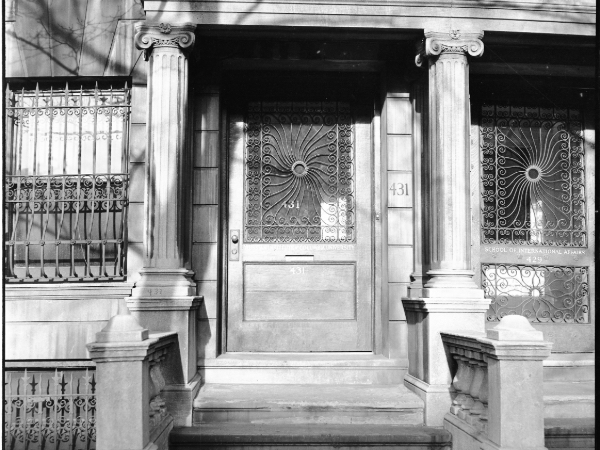
‘In a house that no longer stands, on a street that no longer exists, Columbia University’s Russian Institute opened its doors to its first class in the fall of 1946.’
-Marshall D. Shulman (Graduate of the Russian Institute’s Inaugural Class and First Director of the Harriman Institute)
During the final year of World War II, Columbia scholars and administrators approached the Rockefeller Foundation with a proposal for a new kind of graduate program. By that time, the Soviet Union was already showing that it was indispensable to the wartime alliance that had formed between itself, the United States, France, the United Kingdom and China. As Columbia Provost Frank D. Fackenthal wrote in 1944, there was “every reason to believe that Russia will hold a very powerful place in the world after the war.” American universities, he argued, would therefore need to take Russian studies far more seriously.
The proposed program would combine Russian-language training with advanced work in history, economics, government, international relations, literature, and more. The goal was to train new specialists with a deep knowledge of Russia and the Soviet Union and to bring them together in interdisciplinary dialogue. This was the foundation for the Russian Institute.
The founding faculty brought together leading scholars – Geroid T. Robinson, Philip E. Mosely, Abram Bergson, John N. Hazard, and Earnest J. Simmons – who also had government or policy-related roles during the war. The goal was for them to impart the skills needed to be successful in the academy and capable of achieving distinction in diplomacy, journalism, intelligence, and public administration.
The institute’s creation also reflected emerging Cold War alliances that developed between universities, private foundations, and the federal government. The founders sought to build a lasting scholarly infrastructure that would cultivate a broad coalition of researchers, offering opportunities for publication and building a stronger library and more robust archival collections. In this way, the Russian Institute became an influential model for U.S. “area studies,” organized around the belief that a major world region could be understood only by bringing several disciplines into sustained conversation. Now, 80 years later, that interdisciplinary spirit continues to inform the work of the Harriman Institute.
Throughout the 2026–2027 academic year, we will continue to share our history on our 80th Anniversary page. Stay tuned for stories highlighting the moments and people that have shaped our present.