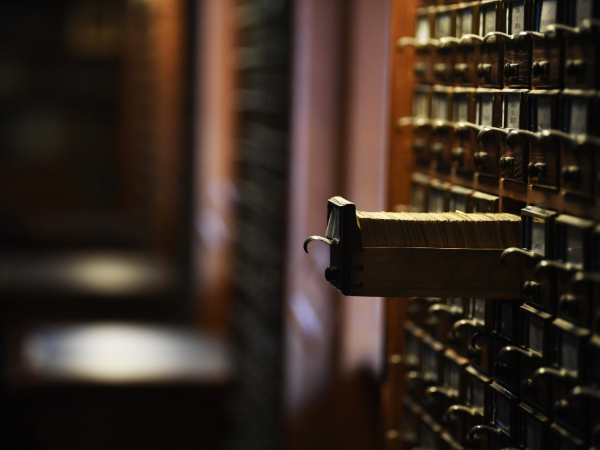
Since its founding in 1946, the Harriman Institute has played a vital role in supporting collection-building at the Columbia Libraries. However, the modern foundations of Columbia’s Slavic, Eurasian, and East European collections were laid decades earlier through a series of significant acquisitions beginning in the early 20th century.
A 1906 gift of more than 2,000 Russian volumes by Count S. Iu. Witte marked the beginning of sustained acquisitions for the collection, with additional Russian materials subsequently provided by the financiers I. N. Seligman, F. M. Warburg, as well as Professor V. G. Simkhovitch. With the support of Columbia president N. M. Butler, an advocate of international scholarship, Columbia’s Slavic and East European collections were flourishing long before area studies entered the academic lexicon.
Recognizing the need for reliable stewardship of Columbia’s Slavic library acquisitions, Geroid T. Robinson and Philip Mosely also established the position of Librarian for Russian, Eurasian, and East European Studies. The post was initially held by Russian émigré bookman Simeon Ja. Bolan in 1946.
In 1956, Bolan was sent to the Soviet Union on behalf of the Russian Institute and Columbia Libraries to purchase new materials and reestablish exchange relations. In a bold effort to increase the library’s holdings, Bolan made a proposal to the Soviets: Columbia would turn over four original letters from Lenin in exchange for some 15,000 retrospective titles and serial issues supplied by the Marx-Lenin Institute. The letters had been purchased by Boris Bakhmeteff, a preeminent Columbia professor and the last ambassador of the Russian Provisional Government, as part of the papers of the Social Democrat Grigorii Aleksinskii. Aleksinskii had broken ties with Lenin and resided in exile in Paris. A collection of three albums containing poetry and drawings, many of them by the Russian poet Mikhail Iur’evich Lermontov, was also considered for trade. Ultimately, the Lenin letters were exchanged with the Soviets, and the Lermontov albums were not. The latter remain with Columbia to this day.
Over the following decades, a succession of librarians expanded and maintained Columbia’s collections. Notable among them was Nina A. Lenček, a Slovenian émigré and philologist who served from 1968 to 1989. Reflecting on her decades of experience with the Columbia Libraries, she expressed the hope that the collections retain their “strength and reputation and remain one of the national centers for the study and research of the Soviet Union and Eastern Europe in the years to come.” She was followed by Eugene Beshenkovsky, Jared Ingersoll, and, most recently, Robert H. Davis, who served from 2008 until his retirement in 2025.
Alongside the growth of Columbia’s Slavic library collections, a separate initiative took shape: the Archive of Russian and East European History and Culture. It was founded in 1951 through the collaborative efforts of Russian Institute founders Philip Mosely and Geroid T. Robinson, Boris A. Bakhmeteff, and Michael M. Karpovich, a Harvard historian and former secretary to Bakhmeteff. Later, in 1973, the archive assumed the name of Bakhmeteff to recognize his role in its foundation and the considerable financial support provided by his Humanities Fund. Today, the Bakhmeteff Archive is the second-largest repository related to the Russian and East European émigré communities in North America – surpassed only by the Hoover Institution Library & Archives at Stanford. The Bakhmeteff Archive is curated by Tanya Chebotarev and includes 1,500 processed collections with more than 1.6 million individual items – including letters, documents, manuscripts, photographs, prints, clippings, and artworks.
Today, thanks to more than a century of collection building efforts by Harriman founders, associates, and forebears, Institute affiliates benefit from unrivaled bibliographical resources.
Photo Credit: Eileen Barroso