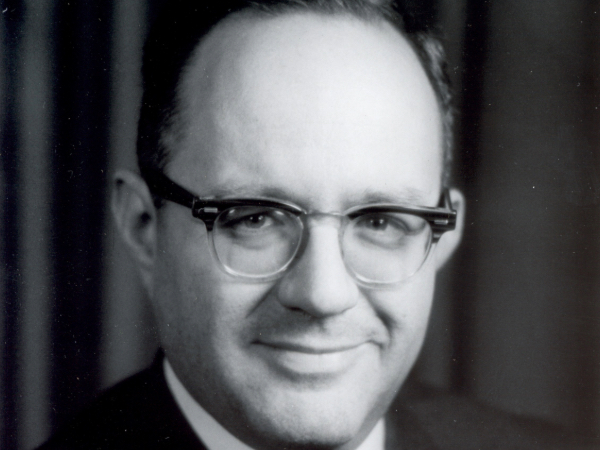
This piece is adapted from the Alexander Dallin Tribute in the Harriman Institute’s 60th Anniversary book. The original piece was written by Mark von Hagen (1954-2019), former director of the Harriman Institute and former Boris Bakhmeteff Professor of Russian and East European Studies at Columbia University.
Alexander Dallin (1924-2000) figures very prominently among the founders of the field that came to be known as Soviet/Russian area studies. He left a large legacy in the institutions he helped to build, in the students he mentored over the decades of his career (I count myself lucky to be among that number), and in scholarship that was marked by balance, fair-mindedness, scrupulous attention to evidence, and intolerance for conventional wisdom. […]
Son of a prominent Russian-Jewish Menshevik, David Dallin (born David Lewin), Alex was born May 21, 1924, after the family had fled Bolshevik Russia for Berlin. […] [After Kristallnacht, the family fled Berlin.] The family sought safe haven in Paris (January 1939), where Alex made contact with the anti-Nazi resistance and eventually with American consular officials to organize the passage of his mother and himself to the United States in a perilous journey through southern France, Spain and Portugal. […]
[After serving in the US Army, Dallin finished college at City College of New York and began graduate work in modern European history at Columbia at the Russian Institute. In 1950 he went to Munich with a Harvard research team to interview Soviet refugees in displaced person camps.] He returned to the US in 1951 to the position of Associate Director of the Research Program on the USSR in New York and finished his doctoral degree at Columbia in 1953. Next he was appointed director of research at the War Documentation Project in Washington, DC, where he read and analyzed many documents that would significantly enrich his future book, Russia under German Rule, 1941–1945 (first published in 1957, republished in 1981), which won the Wolfson Prize in History and remains a classic after nearly 50 years.
In 1956 Alex was appointed to the faculty of Columbia University as an assistant professor in international relations, was quickly promoted to associate and full professor; in 1965 he was appointed the Adlai Stevenson Professor of International Relations. […]
He also served as director of the Russian Institute (now Harriman Institute) from 1962 to 1967 and acting director of the Research Institute of Communist Affairs. The 1968 crisis at Columbia University found Alex a member of the Executive Committee of the Faculty and of the Faculty Senate; he tried to mediate between the student demonstrators and the administration, urging political negotiations and opposing the use of force on both sides. […]
[Alex went on to become Professor of History and Political Science at Stanford, with a shared appointment at the Hoover Institution.] From his new California base, he continued to teach, write, and contribute to the building of national and international area studies. He served as director of the Stanford University Center for Russian and East European Studies (1985-89; 1992-94). […]
Alexander Dallin died July 22, 2000, on the eve of his departure for the VI World Congress for Central and East European Studies in Tampere, Finland. […]
His commitment to public service in the field engaged him in numerous departmental and university committees, and he did so with a sense of obligation and integrity that has earned him the title of a true citizen of the international scholarly community.