
For non-Columbia affiliates, registration is required to access the Morningside campus. After registering you will receive an email with a QR code that must be presented along with a government-issued ID (your name must match exactly the name registered for the event) at either the 116th Street & Broadway or 116th Street & Amsterdam gates for entry. Please register using a unique email address (one email address per registrant) by 4:00 pm on Feb. 6 for campus access.
Names will be submitted for QR codes 1-2 days prior to the event. Registrants will receive an email from CU Guest Access with the QR code before or on the day of the event.
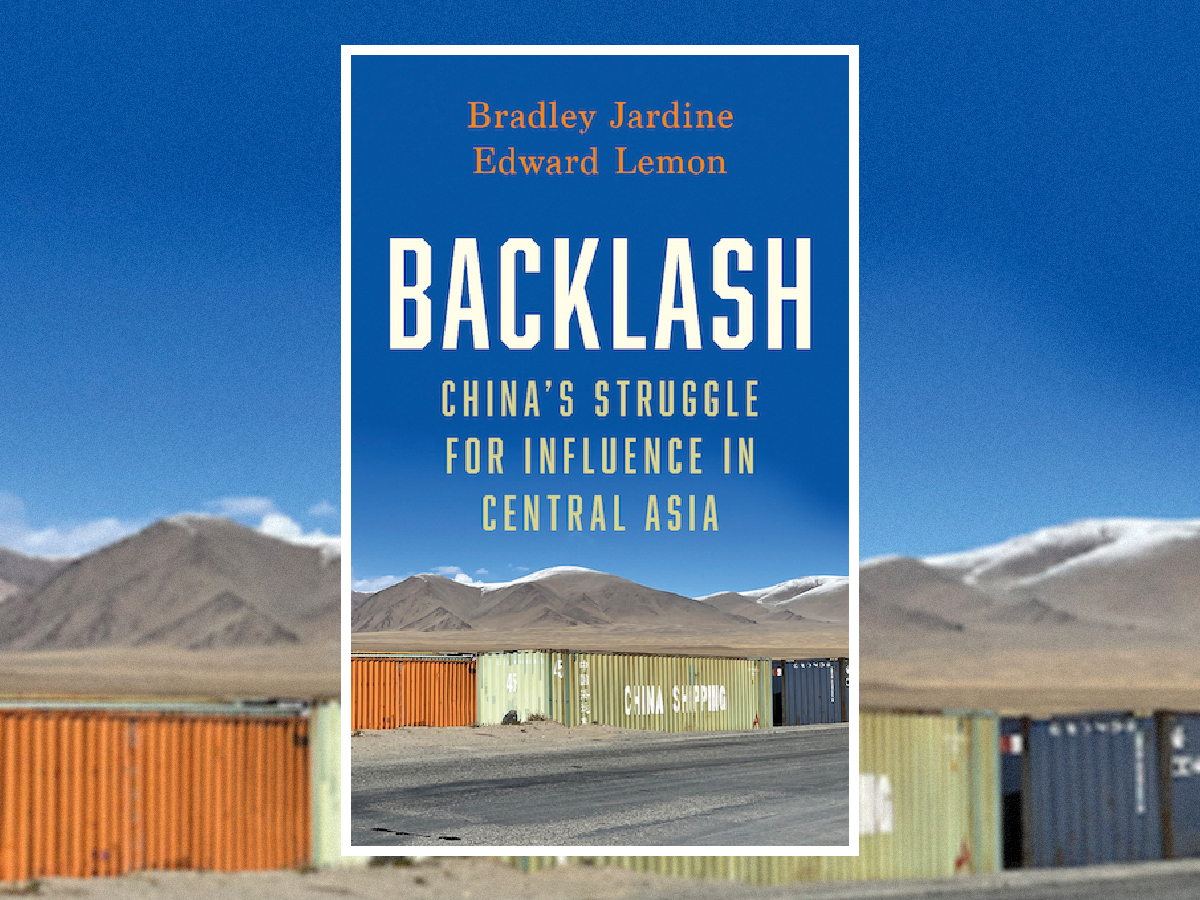
Please join us for the latest convening of the the Borton-Mosely Distinguished Lecture Series, jointly sponsored by the Weatherhead East Asian Institute and the Harriman institute, “Backlash: How Central Asia is Reshaping China’s Rise” featuring Bradley Jardine, Managing Director of the Oxus Society for Central Asian Affairs, and Edward Lemon, President of the Oxus Society for Central Asian Affairs. The event will be moderated by Andrew J. Nathan, Class of 1919 Professor of Political Science, Department of Political Science, Columbia University and Alexander Cooley, Claire Tow Professor of Political Science, Barnard College; Harriman Institute, Columbia University, with discussant Elizabeth Wishnick, Adjunct Senior Research Scholar, WEAI; Senior Research Scientist, CNA.
As global power dynamics continue to fragment, Central Asia stands at the crossroads of strategic opportunity and geopolitical constraint. Long cast as a peripheral zone of great power competition within the spheres of influence of Russia and China, the region is increasingly asserting itself as an autonomous actor balancing relationships with Russia, China, the United States, the European Union, Turkey, India, and the Gulf states through multivector diplomacy. This lecture explores how Central Asian governments and publics are leveraging shifting global alignments, critical mineral wealth, and emerging transit corridors to gain leverage and resist dependency. Rather than being pawns on a chessboard, Central Asian societies are challenging the influence of external powers through protests, critical discourses and armed attacks. External powers are forced to adapt their approach to the region as a result of this backlash.
In an era defined by contested global orders and technological competition, Central Asia has the potential to be not just a bridge between East and West, but a key set of actors asserting themselves in a multipolar world.

Bradley Jardine is a political risk analyst, strategic consultant and Managing Director of the Oxus Society for Central Asian Affairs. He is a former fellow at the Wilson Center and served as editor of The Moscow Times (2016-2018) in Russia. His work has appeared in TIME, The Wall Street Journal, The Economist, Nikkei Asia, The Atlantic and Foreign Policy, and on the BBC and CNN, among others. Bradley is a frequent guest lecturer at the US Foreign Service Institute and resides in Washington, DC.
 Edward Lemon is a research assistant professor at The Bush School of Government and Public Service at Texas A&M University, Washington, D.C., Teaching Site, and president of the Oxus Society for Central Asian Affairs. He was previously a Mellon Postdoctoral Fellow at the Harriman Institute at Columbia University and gained his PhD from the University of Exeter in 2016. He is the co-author (with Bradley Jardine) of “Backlash: China’s Struggle for Influence in Central Asia” (Oxford University Press, 2025). In his research, he examines China and Russia’s relations with Central Asia, authoritarian governance, religion, security, and migration in Eurasia. Since 2009, he has spent almost three years working and conducting fieldwork in Tajikistan, Kyrgyzstan, Kazakhstan, Russia, and Poland. His research has been published in the Journal of Democracy, Democratization, Central Asian Survey, The RUSI Journal, Caucasus Survey, Central Asian Affairs, Foreign Affairs, and the Review of Middle Eastern Studies, among others.
Please email disability@columbia.edu to request disability accommodations. Advance notice is necessary to arrange for some accessibility needs.
