
Registration REQUIRED by 4pm on October 29, 2025 in order to attend this event.
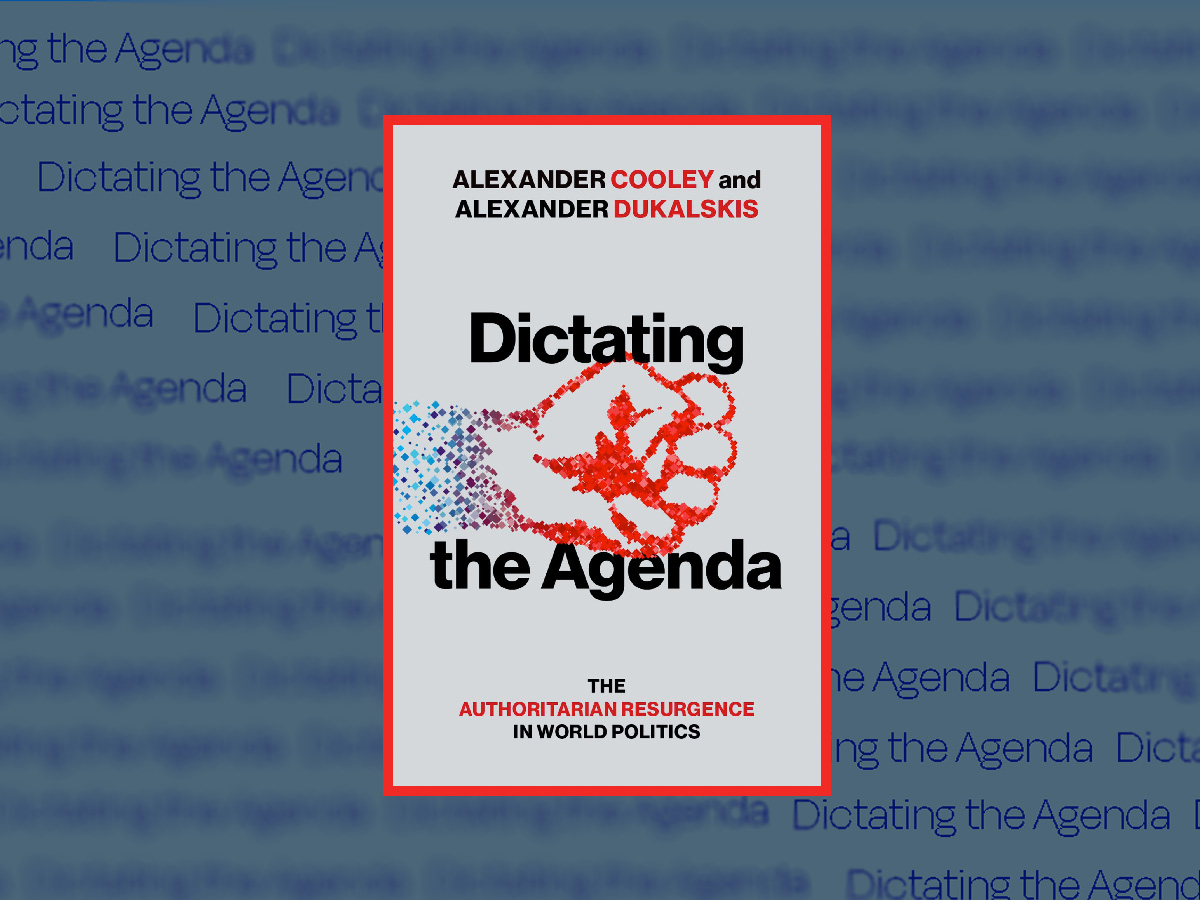
Please join the Harriman Institute and the Committee on Global Thought for a book launch of “Dictating the Agenda” by Alexander Cooley and Alexander Dukalskis. Moderated by Adam Tooze.
Following the end of the Cold War, the world experienced a remarkable wave of democratization. Over the next two decades, numerous authoritarian regimes transitioned to democracies, and it seemed that authoritarianism as a political model was fading. But as recent events have shown, things have clearly changed.
In “Dictating the Agenda,” authors Alexander Cooley and Alexander Dukalskis reveal how today’s authoritarian states are actively countering liberal ideas and advocacy surrounding human rights and democracy across various global governance domains. The transformed global context has unlocked for authoritarian states the possibility to contend with Western liberal soft power in new, traditionally “non-political” ways, including by plugging or even reversing the very channels of influence that originally spread liberalism. Cooley and Dukalskis ultimately advance a theory of authoritarian snapback, the process in which non-democratic states limit the transnational resonance of liberal ideas at home and advance anti-liberal norms and ideas into the global public sphere.
Drawing from a range of evidence, including field work interviews and comparative case studies that demonstrate the changing nature of consumer boycotts, a database of authoritarian government administrative actions against foreign journalists, a database of global content-sharing agreement involving Chinese and Russian state media, and a database of transnational higher education partnerships involving authoritarian and democratic countries, this book doesn’t just reveal the limits of the liberal influence taken for granted across the world. It offers a novel theory of how authoritarian governments figured out how to exploit and repurpose the same actors, tools, and norms that once exclusively promoted and sustained US-backed liberalism.
 Alexander Cooley is the Claire Tow Professor of Political Science at Barnard College, Columbia University. From 2015-21 he served as the 15th Director of Columbia University’s Harriman Institute for the Study of Russia, Eurasia and Eastern Europe and from 2022-2025 as the Vice Provost for Research and Academic Centers at Barnard. Professor Cooley’s research examines how international actors have influenced the governance, sovereignty, and security of the post-Communist states. In addition to his academic publications, Professor Cooley’s commentaries have appeared in Foreign Affairs, New York Times, and Washington Post and he has testified for the US Congress, UK Parliament and the Parliament of Canada.
 Alexander Dukalskis is Associate Professor in the School of Politics & International Relations at University College Dublin. His research and teaching interests include authoritarian politics, human rights, and Asian politics. He is also a frequent expert commentator in national and international media on these themes. From 2022-2024 he directed UCD’s Centre for Asia-Pacific Research. He is the author of two books, “Making the World Safe for Dictatorship” (Oxford University Press, 2021) and “The Authoritarian Public Sphere” (Routledge, 2017), and academic articles in several leading journals.
Adam Tooze is Kathryn and Shelby Cullom Davis Professor of History, Columbia University, Director of the European Institute and Chair of the Committee on Global Thought. He has authored many books on twentieth century and contemporary history, including “Crashed: How a Decade of Financial Crises Changed the World” (2018), “The Deluge: The Great War, America and the Remaking of the Global Order, 1916-1931″ (2014), and “The Wages of Destruction: The Making and Breaking of the Nazi Economy” (2006). He writes the “Chartbook” newsletter and his columns and commentary can be found in The Financial Times, Foreign Policy and other publications.
