
Registration REQUIRED by 4pm on November 9, 2026 in order to attend this event.
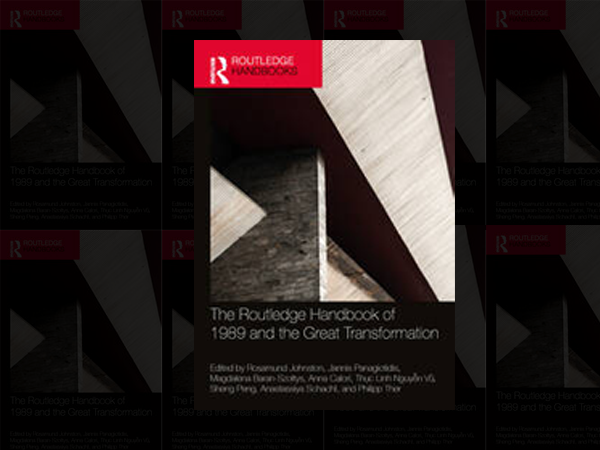
Please join the East Central European Center and the Harriman Institute for a book panel on The Routledge Handbook of 1989 and the Great Transformation, featuring editors Rosamund Johnston and Philipp Ther. Moderated by Małgorzata Mazurek.
This cutting-edge collection of essays analyzes 1989 as a pivotal year for exploring longer-term economic, social, political, and cultural transformations linked to the rise of neoliberalism and globalization since the 1970s and continuing to the present.
Drawing on Karl Polanyi, the handbook argues that the “great transformation” presented here began well before 1989. It also brings Eastern and Central Europe into conversation with other global regions, while challenging straightforward core-periphery dichotomies. The contributions to this volume provide different case studies—some national, some comparative, some international or global—each illustrating particular trends and developments.
The handbook is directed at students and scholars of East Central Europe, of global and economic history, and at scholars of sociology, anthropology, and political science interested in post-1989 transformation, neoliberalism, and globalization.
 Rosamund Johnston is a researcher at the Research Center for the History of Transformations (RECET), University of Vienna. She completed her Ph.D. at New York University. She is the author of Red Tape: Radio and Politics in Czechoslovakia, 1945-1969 (Stanford, CA: Stanford University Press, 2024) and is currently a leader of the research project Linking Arms: Central Europe’s Weapons Sector, 1954 – 1994 that examines how arms production shaped interactions between workers, businesspeople, and politicians in Central Europe and underlay the region’s relationship with the rest of the world.
 Philipp Ther is Professor of Central European History at the University of Vienna and the creator of the research network ‘Research Center for the History of Transformations’ (RECET). A holder of the Wittgenstein Award, the highest Austrian recognition for outstanding research, Ther’s research focuses on Central and Eastern Europe’s social and cultural history of the 19th and 20th centuries, as well as on comparative studies of nationalism, mass flight and migration, and historical theories. His two recent books on the post-1989 economic reforms and their social impact, and the history of refugees and refugee integration in modern Europe, have been published in English by Princeton University Press.
