
This event is online only.
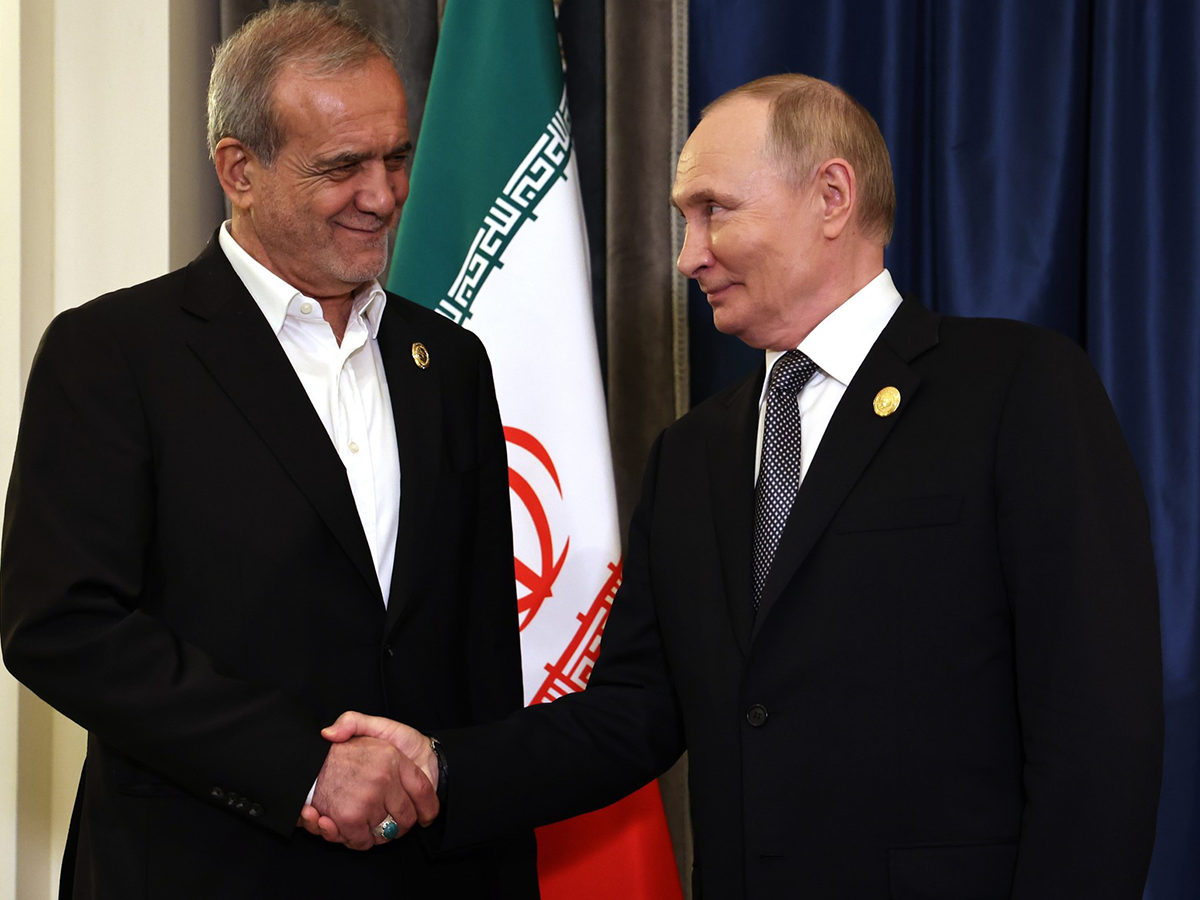
Please join the Harriman Institute for Russia-Iran Relations: An Analytic Update.
Speakers
Nicole Grajewski, Assistant Professor at the Centre de Recherches Internationales (CERI), Sciences Po
Kimberly Marten, Professor of Political Science at Barnard College, Columbia University
Carol Saivetz, Senior Fellow, MIT Security Studies Program; Research Associate, Davis Center for Russian and Eurasian Studies and Ukrainian Research Institute, Harvard University
Moderated by:
Valentina Izmirlieva, Director of the Harriman Institute
Biographies
 Nicole Grajewski is a tenure-track assistant professor at the Centre de recherches internationales (CERI), Sciences Po in Paris. She is also an associate with the Project on Managing the Atom at Harvard’s Belfer Center for Science and International Affairs. A specialist on Russia and Iran, Nicole’s work examines the nuclear and military policies of both states and the bilateral Russia–Iran relationship. Her research on Russia focuses on nuclear strategy and forces, limited nuclear war, and escalation management, including nuclear–conventional integration, force employment, and the role of space and counter-space capabilities in Russian decisionmaking. Her work on Iran centers on nuclear decisionmaking and missile forces, with particular emphasis on the Islamic Revolutionary Guard Corps and the operational role of missile warfare in deterrence and escalation. Grajewski is the author of Russia and Iran: Partners in Defiance from Syria to Ukraine (Oxford University Press/Hurst, 2026). She regularly analyzes and comments on Russian and Iranian nuclear and military developments, with her writing appearing in Foreign Affairs, Foreign Policy, and The Atlantic. She is frequently quoted by leading outlets including The New York Times, The Wall Street Journal, The Financial Times, The Washington Post, and The New Yorker. Previously, she was a fellow in the Nuclear Policy Program at Carnegie in Washington, D.C. and has held appointments at Harvard Kennedy School’s Belfer Center for Science and International Affairs, the European Council on Foreign Relations, and the Notre Dame International Security Center. She received her PhD from the University of Oxford in the Department of Politics and International Relations
 Valentina Izmirlieva is the Director of the Harriman Institute and a scholar of Balkan and East Slavic religious and political cultures, with a focus on multi-ethnic and multi-religious empires and their successor states. The topics of her publications range from the medieval societies of the Mediterranean and the Black Sea regions, including Kyivan Rus’, to the post-Soviet cultural space. The recipient of many awards and distinctions, including the Fellowship at the Cullman Center for Scholars and Writers at the New York Public Library, Professor Izmirlieva delivered the inaugural memorial Shevelov lecture of Ukrainian Studies in 2018. She founded and leads Black Sea Networks, a global initiative to investigate the Black Sea as a hub of cultural, political, and historical interest.
 Kimberly Marten is a professor of political science at Barnard College, Columbia University, with expertise in international security, Russia, and the global politics of climate change. She is a faculty member and executive committee member of Columbia’s Harriman Institute for Russian, Eurasian and East European Studies, and Saltzman Institute of War and Peace Studies. Her recent publications have analyzed the Wagner Group and other Russian paramilitaries; Russian actions in Europe and the Middle East; Russia/NATO relations and the Russian reaction to NATO enlargement; and the politics of the changing Arctic. She has testified before Congressional committees four times and written four books, including Engaging the Enemy: Organization Theory and Soviet Military Innovation (Princeton, 1993), which received the Marshall Shulman Prize. She has written over 30 academic journal articles and book chapters, and more than 50 policy analyses in the Washington Quarterly, Survival, Foreign Affairs, War on the Rocks, Lawfare, the New York Times, the Guardian, and the New Republic, among others. The Council on Foreign Relations commissioned her special report, Reducing Tensions between Russia and NATO (2017), and the Center for a New American Security commissioned her co-authored report on Potential Russian Uses of Paramilitaries in Eurasia (2024, with Andrea Kendall-Taylor, Carisa Nietsche, Nicholas Lokker and Kristen Taylor). She gives frequent invited presentations to the policy community, and appeared on The Daily Show with Jon Stewart to speak about Russian actions in Ukraine. She earned her A.B. at Harvard and Ph.D. at Stanford. She is a member of the Council on Foreign Relations and the International Institute for Strategic Studies.
 Carol R. Saivetz is a Senior Fellow in the MIT Security Studies Program. She is also a Research Associate at Harvard’s Davis Center for Russian and Eurasian Studies and the Harvard Ukrainian Research Institute. She holds an M.I.A., M.Phil., and a Ph.D. from Columbia University in Political Science and a certificate from what is now the Harriman Institute at Columbia. Between 1995-2005, she was the Executive Director of the American Association for the Advancement of Slavic Studies and between 1992-2006 she was a Lecturer in Government at Harvard. She is currently teaching Russian Foreign Policy in the Political Science Department at MIT. She is the author and contributing co-editor of 5 books and numerous articles on Soviet and now Russian foreign policy issues, including Russian policies toward the other Soviet successor states, the many facets of Russia’s war against Ukraine, Russian-Iranian and Russian-Turkish relations, and current U.S.-Russian relations. She has also published opinion pieces on the Ukraine crisis, Russian intervention in Syria, Russian approaches to the conflict in Nagorno-Karabakh, and Russian-Iranian relations for several outlets and commented on events in Russia, Syria, and the Ukraine war for local radio and TV. She is the co-chair of the MIT seminar series “Focus on Eurasia,” sponsored by the MIT Security Studies Program, the Center for International Studies, and MIT-Eurasia.
Event Video
Please email disability@columbia.edu to request disability accommodations. Advance notice is necessary to arrange for some accessibility needs.
