
Registration REQUIRED by 4pm on March 5, 2026 in order to attend this event.
Please join the Harriman Institute for a Russian History Workshop with Victoria Frede. Moderated by Catherine Evtuhov.
The cult of friendship arrived in Russia in the mid-1750s, during the reign of Elizabeth (r. 1741-1762). Hoping to tame the fractious clans that dominated Russian politics at the time of her enthronement, her advisors discovered friendship as a disciplinary remedy. A voluntary relationship between adults who selected one another to practice higher ideals in tandem, it would breed a new type of statesman, whose relationship to the state, too, would become a voluntary, virtuous commitment. This ideal became key to her governing ideology: casting as the goddess, Astraea, she would preside over the return of a “golden age” of virtue, peace and plenty. Tracing the adoption of the cult of friendship, the chapter contrasts correspondence between Elizabeth’s advisors of the 1740s against those of the later 1750s. Led by her favorite, Ivan Shuvalov, they rapidly began to mix invocations of friendship with those of civic virtue: zeal for the wellbeing of the empress, fatherland, and common good.
Victoria Frede is an associate professor at the Department of History in Berkeley. She is the author of Doubt, Atheism, and the Nineteenth-Century Russian Intelligentsia (2011) and of numerous articles on the eighteenth and nineteenth centuries.
Interested participants should contact Erin Forrest (ef2847@columbia.edu) for a copy of the paper, to be distributed no earlier than two weeks before the workshop.
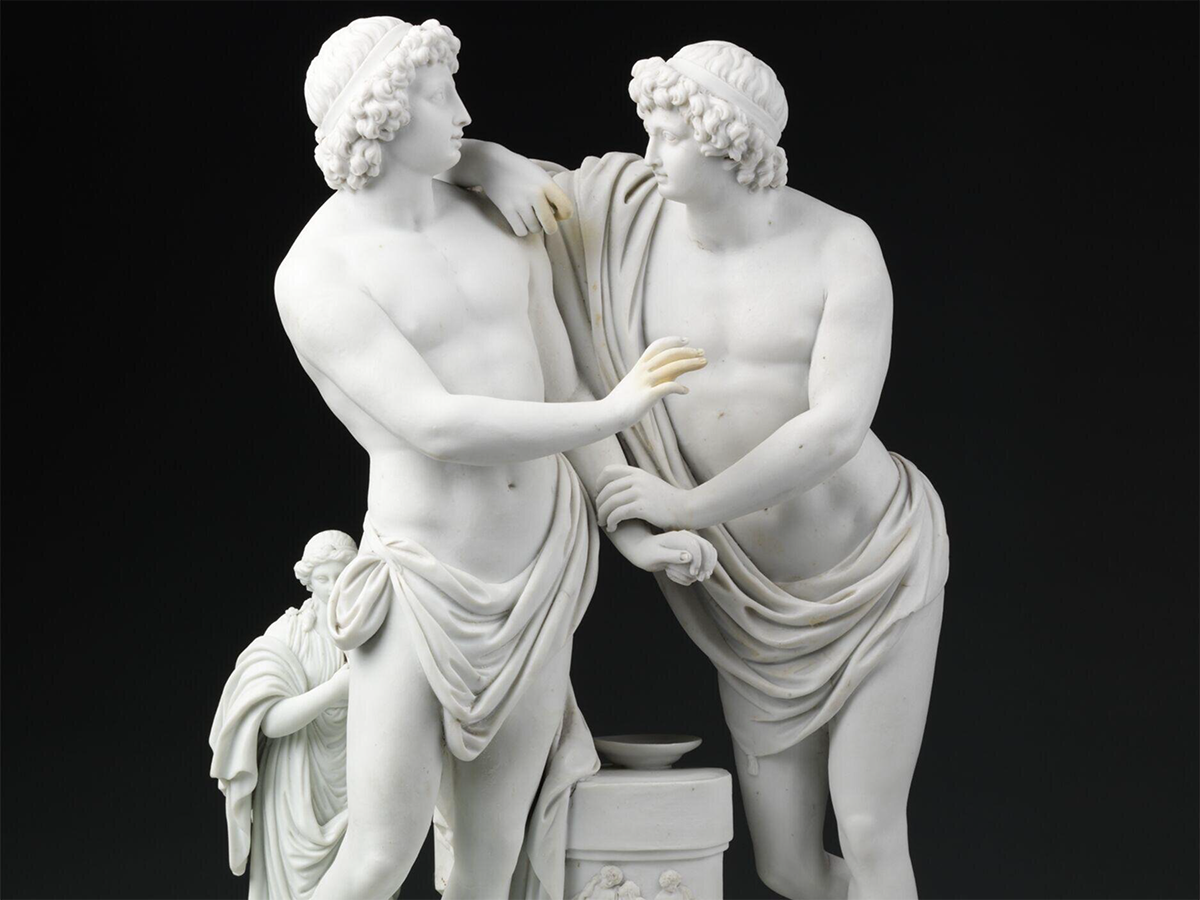
Image: A statue of Orestes and Pylades
Please email disability@columbia.edu to request disability accommodations. Advance notice is necessary to arrange for some accessibility needs.
