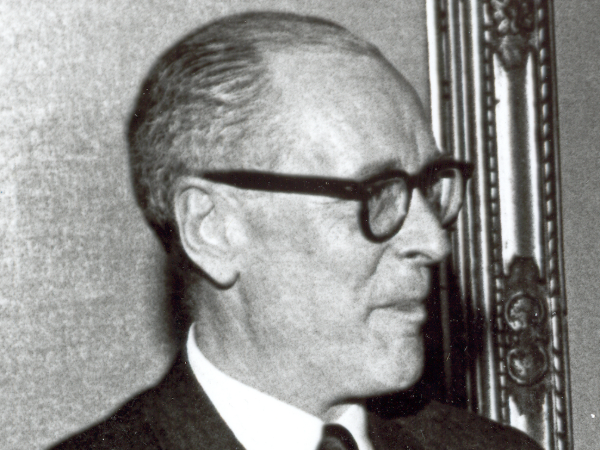
Henry Roberts, the third director of the Russian Institute and the founding director of Columbia’s program in East Central European studies, was uniquely positioned to bridge the study of Russia and Eastern Europe as interest in ‘area studies’ expanded in the American academy. Though initially trained as a historian of modern Germany, Roberts’s interests turned to Eastern Europe during World War II. He served in the research and analysis division of the Office of Strategic Services and was stationed in Romania from 1944 to 1945. His experience in the country would prove foundational for the remainder of his career. In 1948, he completed his D.Phil. at Oxford with a dissertation on Romania—a work that he would later develop into his first book, Rumania: Political Problems of an Agrarian State.
Roberts joined Columbia’s History Department in 1948. A $250,000 grant from the Carnegie Endowment funded the creation of Columbia’s Program on East Europe in 1954, and Roberts was named its first director. At the time, however, he was on leave from the university, working for the Council on Foreign Relations as research director for studies on Soviet-American relations. The core of the new East European Studies program was a series of international relations courses taught by Roberts and Philip Mosely, then-director of the Russian Institute.
In 1956, Roberts succeeded Mosely as director of the Russian Institute, placing him at the head of both programs. The dual appointment gave Roberts the opportunity to explore the relationship between the Soviet Union and its Eastern European neighbors, while challenging him not to obscure the distinctive histories of the countries themselves. Roberts understood that the intellectual concerns of Eastern European studies were “not and will not be identical with those of Russian studies and should not be lumped with them except for specifically defined purposes.”
Like his RI predecessors, Roberts maintained close relationships with the American government and the intelligence community. He corresponded with CIA Director Allen Dulles, sharing Russian Institute reports and inviting Dulles to speak with students. Dulles, for his part, facilitated exchanges between Institute scholars and Agency officials. Yet Roberts resisted reducing the intellectual significance of Russian area studies to Cold War priorities. Writing in 1964, he insisted that the growth of the field “[should] not be reduced to a ‘cold war’ aim of ‘knowing your enemy,’” emphasizing instead the broader scholarly possibilities opened by the concurrent study of Russia and Eastern Europe.
Remembered by colleagues and students as an encouraging but demanding teacher, Roberts helped guide the Institute through a period of considerable intellectual and institutional expansion. The core tenets of his philosophy continue to inform the approach of the Harriman Institute to area studies, and especially its longstanding institutional relationship with the East Central European Center.