
By Ann Cooper
In the early weeks of 2022, Yana Balanchuk’s (MARS-REERS ‘27) school, the National University of Kyiv-Mohyla Academy, was making plans for a return to in-person classes after two years of remote learning during the COVID pandemic. Then, on February 24, Russia launched its full-scale invasion of Ukraine. Some students immediately volunteered for military service. Others fled for greater security in cities or European countries west of Kyiv. All quickly learned to face the terrible news of lives lost in the war – family, friends, fellow students – and to cope with the fact that far too many young Ukrainians would now never graduate from college, have careers, or start families.
As the casualty list grew, so did a sense of urgency: “We have to do something to commemorate their lives,” Balanchuk remembers. “It is the only thing we can do for them.”
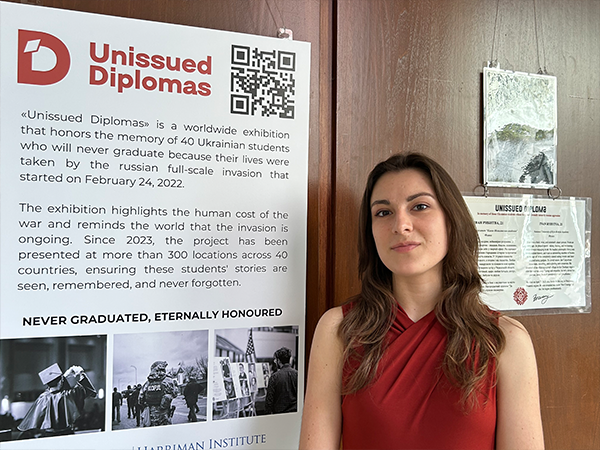
“Unissued Diplomas,” an exhibit currently stretching across a long wall of the fourth-floor lobby in Columbia’s International Affairs Building, is the result of that idea. It features black and white photos of 21 young Ukrainians, aged 17-23, who died in the war. Some were soldiers on the front lines. Some died trying to rescue others: Danylo Bolshakov, 22, a student at Mariupol State University, was buried under concrete slabs when a Russian missile strike hit his family home as he tried to save his father and grandmother.
Others died while going about their daily lives. Oleksandra Borivska, 18, was killed July 2022 in a Russian missile attack on her way to a driving lesson in Vinnytsia; the same day, Olha Lysenko, 20, was headed home from the dentist in Vinnytsia when she was badly burned in the Russian attack. She died after a week in hospital.
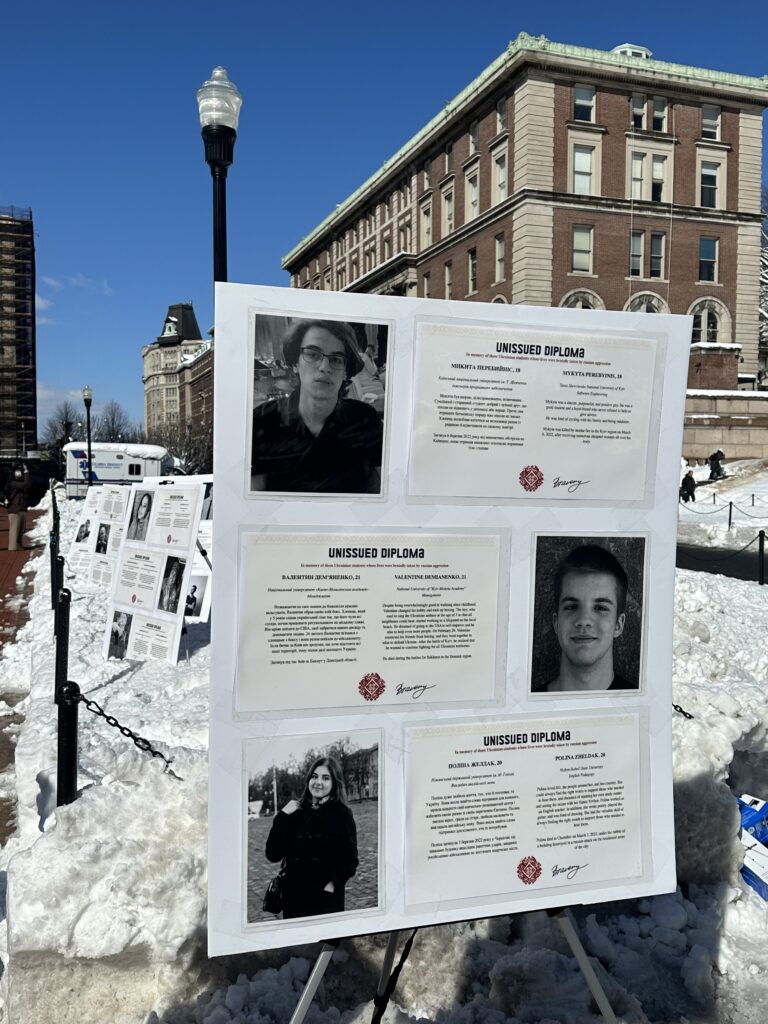
Unissued Diplomas exhibit on College Walk (Photo Courtesy of Yana Balanchuk. February 24, 2026)
Photographs of Bolshakov, Borivska, Lysenko, and the remaining 19 are displayed on posters recounting their interests, accomplishments, and dreams for the future. Ivan Rybytva, 21, was studying physics at Kyiv-Mohyla Academy before he enlisted in the military. His poster describes him as “bold, wise, extremely smart.” He loved sports and ancient history “and read an astounding number of books” before he was killed in a battle for Bakhmut, in Ukraine’s Donetsk region. Ukraine honored him with its Order for Courage Third Class.
Perhaps most poignant in the “Unissued Diplomas” exhibit are the hopes that ended with each student’s death. The multitude of career ambitions: lawyer, diplomat, landscape architect, pastry chef. Dreams of travel: Scandinavia, Egypt, the Grand Canyon, or simply wishes “to see the world.”
“All of them are young people who had ambitions. Some of them had families. They were people, just like us,” said Balanchuk.
She is one of dozens of Ukrainian students globally who helped organize the exhibit with “the goal of commemorating the lost lives of the Ukrainian students and reminding the world that the full-scale war still rages on,” according to the project’s website. The global focus is intentional; the exhibit has been shown in more than 300 locations in 40 countries.
“The goal of this exhibition is to tell the story abroad,” said Balanchuk. “Because in Ukraine, everybody knows it. We all have friends who we lost.”
Balanchuk first brought the exhibit to Columbia on February 24, 2026, the fourth anniversary of Russia’s full-scale invasion. That first Columbia exhibit almost didn’t happen, though, due to the blizzard that shut down much of New York just before the anniversary. Among the closed businesses was the print shop making the exhibit posters. But one employee, aware of the importance of the date, came in to finish the job so that Balanchuk could mount the posters along Columbia’s College Walk on February 24.
Later, the Harriman Institute helped Balanchuk arrange to have the posters displayed in the International Affairs Building, where they will remain until April 30.
After four years of news coverage of the full-scale war, much of the public may be fatigued with reports on frontline movements and failed peace talks. “Unissued Diplomas” directs attention to the fallout from those stories: the ongoing human toll, said Balanchuk. “It’s about people – first of all about people.”
Pictured: Yana Balanchuk in front of the Unissued Diplomas exhibit description in the SIPA building.
