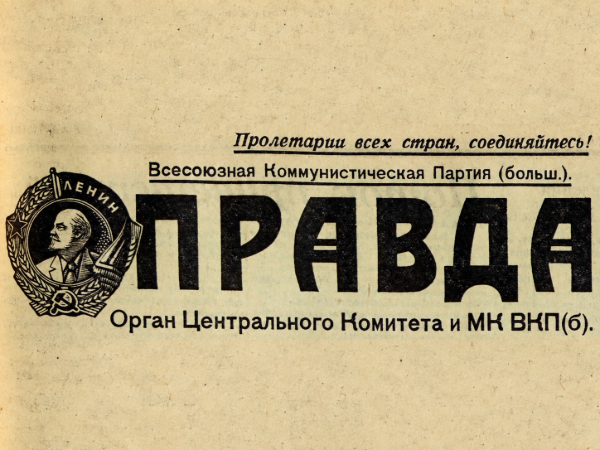
The Russian Institute’s reputation as America’s foremost Soviet studies research center in the late 40s and 50s generated natural suspicions among the United States’ geopolitical rivals in the East, provoking passionate hostilities in critics writing for Russia’s most prominent newspaper, Pravda. When word of the Russian Institute made its way to Moscow, these critics went on the attack.
On July 24, 1951, an unnamed Pravda journalist didn’t mince words:
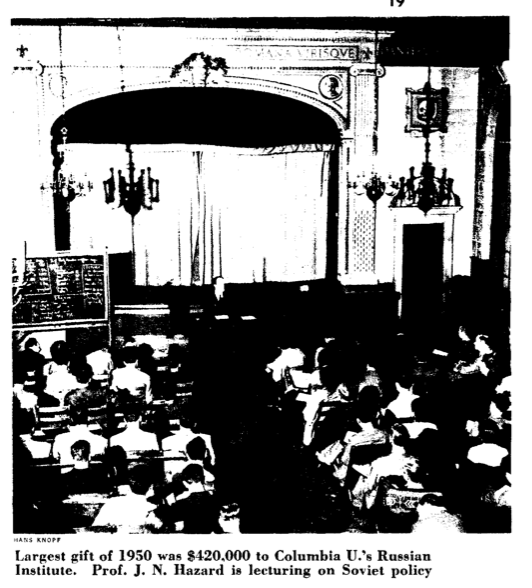
Collier’s magazine (April 28) calls the establishment of a special ‘Russian Institute’ at Columbia University, funded by the Rockefeller Foundation, an outstanding ‘cultural’ event. In the photo, we get a look at this breeding ground for American slanderers, spies, and saboteurs.
Young men and women are trained in anti-Soviet fervor as dogs in a breeding kennel. Know-nothing ‘professors’ teach courses in complete nonsense to young students, who have been selected for their superlative mental deficiency and wholesale lack of moral integrity. American youngsters fashioned by these methods are called to replace the discredited Smerdyakovs working in the press and on the radio.
For the April 10, 1952 issue of Pravda, Evgeni Litoshko and Ivan Filippov visited Columbia to gather information for a broad profile on intellectual life at the university. They reserved a few choice words in their article for the Russian Institute:
The ‘learned gentlemen’ of the ‘Russian Institute’ are completely uninterested in an objective and truthful study of life in the Soviet Union – its politics, economy, and culture. The Institute is exclusively engaged in training military and diplomatic intelligence officers for various agencies of the United States government. […] The Institute is headed by rabid reactionaries such as Professors Mosely, Robinson, and Simmons, who systematically poison their students’ minds with slander against the Soviet Union.
Ironically, these Soviet critiques were leveled against the Russian Institute in the peak years of McCarthyism. Without exception, Mosely, Robinson, and Simmons – the very professors Pravda accused of corrupting American minds with anti-communist propaganda – had to contend with McCarthyite accusations that they were, in fact, subversively spreading communist sympathies among their students. The contradiction itself is revealing. From both sides of the Cold War – true to the polarized spirit of the times – the attempt to understand the opposing culture from the inside was too often misconstrued as evidence of ideological sympathy.