
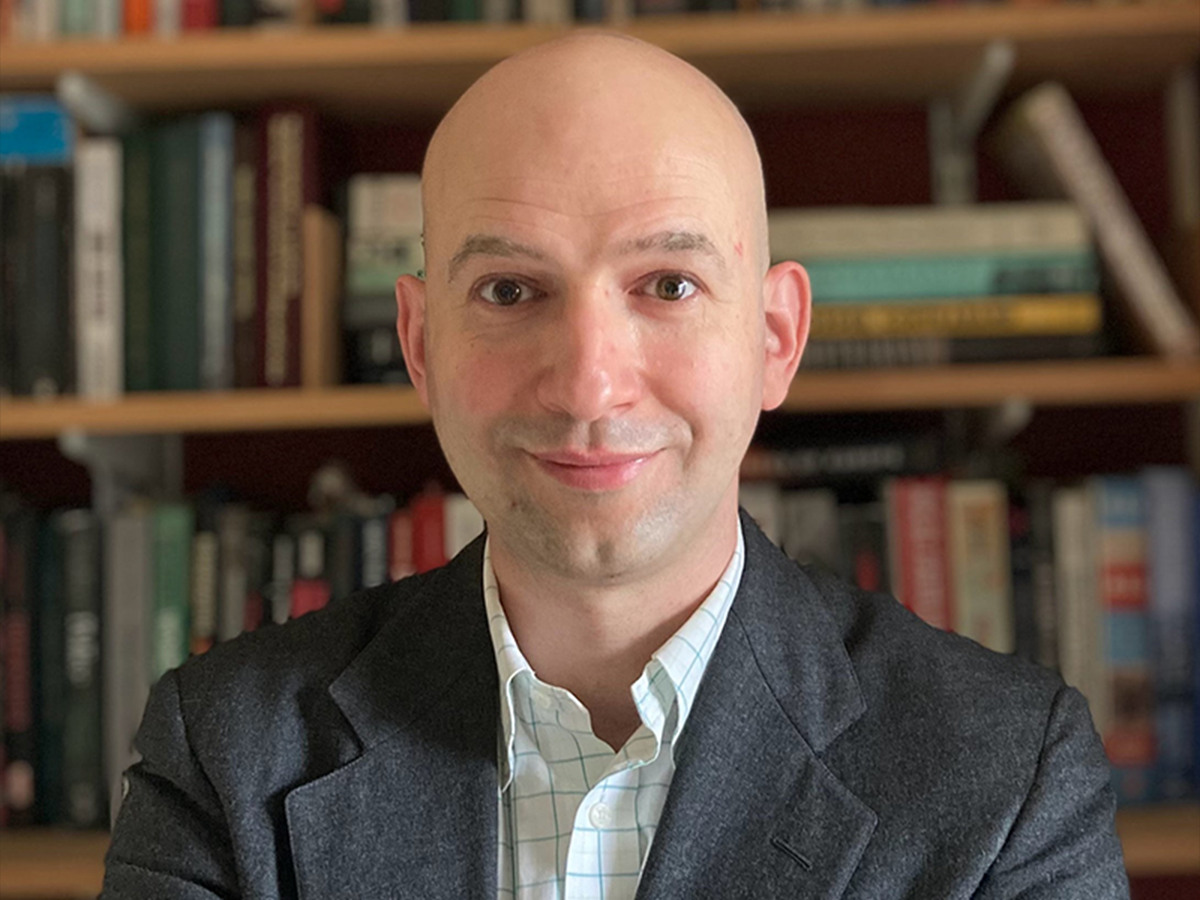
Andrey Shlyakhter, Lecturer in History, is an international historian of the Soviet Union and its neighbors. His work examines how economics, security, and ideology intersect at state frontiers. He received his Ph.D. in December 2020 from the Department of History at the University of Chicago. His comparative dissertation, “Smuggler States: Poland, Latvia, Estonia, and Contraband Trade Across the Soviet Frontier, 1919-1924,” won the 2021 Ab Imperio Annual Award for Best Dissertation Chapter and was a finalist for the 2022 Herman E. Krooss Prize for Best Dissertation in Business History. His book project, Smuggled Goods, Soviet Borders: Contraband Trade and the Making of the Soviet System, 1917-1930, grows out of this research. Dr. Shlyakhter was the 2024-25 Petro Jacyk Post-Doctoral Fellow in Ukrainian Politics, Culture, and Society at the University of Toronto, and has been appointed the 2026-27 Temerty Post-Doctoral Fellow in Holodomor Studies at the University of Alberta.
Can you tell us a bit about your background and how it shaped the trajectory of your career?
It has been said that all research is “mesearch.” I wasn’t thinking in those terms when I chose to study smuggling across Soviet borders, but there were personal reasons this topic drew me in. Leningrad, where I grew up in the twilight of the Cold War, was considered cosmopolitan. Even so, my classmates and I bartered and fought over foreign gum wrappers and gaped at tourists. The word importnyi (imported) had a magical pull. But even more magical were old objects, especially coins, because I could imagine the stories behind them and the hands they had passed through. Later, as a scrappy immigrant kid in 1990s Boston, I developed an appreciation for the ability to adapt, to make do with little, to cross cultural boundaries: the qualities of a smuggler. I suppose that my research has fused all my childhood fascinations with things old, foreign, and forbidden.
Can you briefly tell us about your book project?
My book project, Smuggled Goods, Soviet Borders: Contraband Trade and the Making of the Soviet System, 1917-1930, is a history of contraband trade during the formative years of the Soviet state. It traces the co-evolution of two core features of the Soviet system: the shadow economy and the border. For Soviet citizens, smuggling supplied everything from daily necessities to foreign fashions. For Soviet leaders, the traffic was both an economic menace and a security threat: draining the hard currency and raw materials needed to finance industrialization, while offering cover for espionage. The struggle with smuggling became a laboratory for border control. Smugglers thus inadvertently helped reinforce the very borders they violated. This was not a uniquely Soviet dynamic, but the scale of illicit trade, the ease with which new coercive capacities could be repurposed, and the centrality of border control to Stalinist isolation and the Iron Curtain gave smuggling, and the Soviet struggle against it, a unique significance.
What courses will you be teaching at the Harriman Institute? Can you briefly describe some of the ideas you will be discussing in each course?
This spring I will offer two courses. The first is an undergraduate lecture course, “Breadbasket, Borderland, Battleground: Economy, Space, and Power in Ukraine, ca. 750 BCE — 2026.” This course grows out of my work on smuggling – the interplay of economics, geography, and politics — which also happens to be a particularly productive way of thinking about Ukrainian history. From the steppe-settlement interactions and trade routes that shaped medieval Rus’ to the fraught relationship between industrialization, urbanization, and Russification in the 20th century, centering the interplay of economy, space, and power helps students make sense of Ukraine’s multinational, millennia-long story. I am particularly excited about incorporating numismatics, because coins and banknotes help render those abstractions tangible. The second course is “Debating the Holodomor,” a graduate seminar that introduces students to the rich historiography of the Ukrainian famine of 1932-34. Without losing sight of the human tragedy, we will focus especially on the contentious questions of causality, intent, and agency.
What do you hope students will walk away with after taking your courses?
The history of Ukraine is dizzyingly diverse. It’s a story of Iranic and Turkic nomads, Greek colonists, Viking traders, Catholic nobles, Orthodox peasants, Jewish tavernkeepers, and frontier Cossacks — as well as Polish, Russian, Ottoman, Austrian, Soviet, and German rule. I want my students to leave with an understanding of how and why this kaleidoscope turned as it did. This means cultivating cognitive empathy: learning to see the world through the eyes of people to whom we can hardly relate. That becomes especially hard when we confront atrocities like the starvation of millions of Ukrainians under Stalin. The sheer brutality compels a moral response. However, the danger is that we gravitate toward simplified explanations that feed our sense of moral superiority, but inhibit inquiry. As Moscow again brutalizes Ukraine, the desire to mobilize the past is more than understandable. It is a luxury to sit in safety at Columbia and debate Stalin’s intentions — but I want my students to use this privilege responsibly and to follow the evidence, debating all the way about where it leads.
