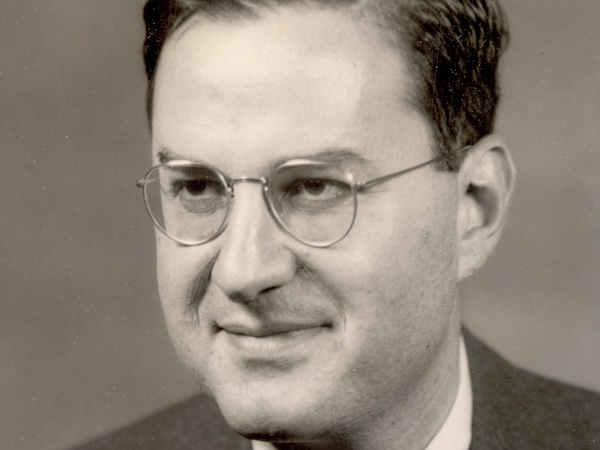
– Excerpted from Padma Desai’s tribute to Bergson in Harriman’s 60th Anniversary
I discovered the progression of events that contributed to Abe’s becoming a comparativist as he described himself professionally in his memoirs. He [Bergson] could have studied physics at the suggestion of his elder brother Gustav, but turned instead to economics when he became a graduate student at Harvard in 1933 at the age of 23. The Great Depression was under way and the prospects of an economist landing a job were uncertain. But Abe stuck to his decision. Already a brilliant theorist with an original, oft-cited paper on the social welfare function to his credit, he was soon to embark on the empirical analysis of the Soviet system, beginning with an investigation of the massive data on Soviet wage differentials. In the process, he ended up by founding the field of comparative economic systems and gave it a touch of class through a superb combination of analytical depth and empirical rigor. The British, they say, forged an empire in a fit of absent-mindedness. Abe established a whole new field of inquiry and analysis through a series of “fortuitous” circumstances.
As a graduate student in the economics department at Harvard, Abe was fascinated by the momentous theoretical debates that raged during the interwar years on the economic merits of socialist economies. And yet scholarly research on the subject was missing. In his view, Marx’s claim on the presumed superiority of socialism went unchallenged, leaving several questions unanswered. How efficient were Abram Bergson (1914–2003) 29 faculty portraits socialism’s working arrangements in comparison with those in market economies? What methods might be employed for addressing this issue? Can one actually derive measures indicating the differences in the economic performance of the two systems? Might one conclude that the Marxist faith in the economic potency of socialism was misplaced? At the outset, how might one define socialism and efficiency?
Abe’s substantial work stretching over half a century—scientific, meticulous, and innovative in its application of concepts and measurement yardsticks—cast doubt on the functioning of socialist economies over time and in relation to their market economy counterparts. He presented his results, always emphasizing the limitations of his methods and the data, and without claiming to guarantee their infallibility. While demonstrating that the Soviet economy had serious and mounting problems, he never claimed to be a prophet. He was more a seismologist concerned about the escalating rumblings in the edifice rather than a forecaster of when and how it might crumble. Its sudden and ultimate “denouement” in 1991 surprised us all.
I managed to keep in touch with Abe since leaving the Russian Research Center in 1980. Abe’s impact on my academic endeavors has stayed with me. These have proliferated in various directions from my earliest efficiency-related work of the Soviet economy to the new issues sweeping Russia’s economic transition. But the watchwords in my research progression have been rigorous analysis combined with reliable information, and sensible conclusions based on their interaction. That has been Abe’s legacy for me and his successors. I often think of him warmly and gratefully.
Abram Bergson, a founding member of the Russian Institute in 1946, had come to Columbia the previous year.