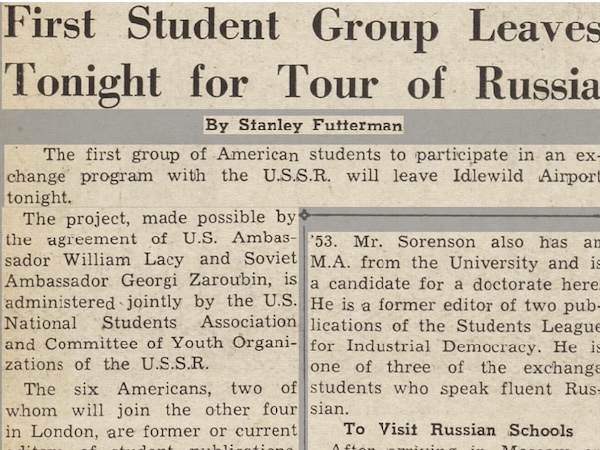
Following the collapse of McCarthyism in the United States and the death of Stalin in the USSR, more opportunities for collaboration between Soviet and American institutions opened up. The landmark Lacy-Zarubin agreement of 1958 created the first organized academic exchange between the U.S. and USSR. Prior to the Lacy-Zarubin agreement, American students hoping to visit the Soviet Union had little hope of their dreams being fulfilled; the few who had visited the USSR before then, in 1954, were awarded tourist visas on the basis of letters they sent to Premier Khrushchev. This experience inspired Russian Institute alumnus Peter Juviler, who had visited Moscow, Leningrad, and Kyiv after receiving a two week visa in 1955, to lobby the Ford Foundation to help create an official exchange program for American and Soviet Students.
This program, which was enshrined in the Lacy-Zarubin agreement, saw the Russian Institute send exchange students to the USSR from 1958 to 1959, and host Soviet students in 1959. One of these Soviet students was Aleksandr Yakovlev, who came to Columbia as a graduate student studying President Franklin D. Roosevelt’s New Deal and foreign policy. Yakovlev would go on to become Gorbachev’s senior advisor and the “godfather of glasnost.” Already a member of the Central Committee of the Communist Party, Yakovlev was one of four Soviet students in the first Lacy-Zarubin cohort. Two of the other exchange students were KGB members, and the fourth a member of Soviet military intelligence (GRU).
The first Lacy-Zarubin cohort included 22 students, seven of whom were Russian Institute students. One of those participants, future director of the Russian Institute Alexander Dallin, wrote that the exchanges gave the cohort “a feel for the scene…the instinct to judge the plausible from the ludicrous.” Dallin believed that the Americans had a significant, but at the time imperceptible, impact on every Soviet citizen they interacted with, and that exposure to the outside world had a transformative effect.
The Lacy-Zarubin agreement opened the doors for exchange between the Russian Institute and its region of study, and exchange remains a critical component of the institute’s work. Students and faculty of the Harriman Institute today frequently travel to the region, and while Russia’s full-scale invasion of Ukraine has limited the opportunities for direct exchange, Harriman students and scholars have continued their study of Russia and Ukraine in innovative ways. Harriman is proud to host visiting professors and writers in residence every year, and international students form a critical component of the Harriman community. These scholars are continuing a tradition of academic exchange at Harriman that has existed since the Lacy-Zarubin agreement was signed almost 70 years ago.