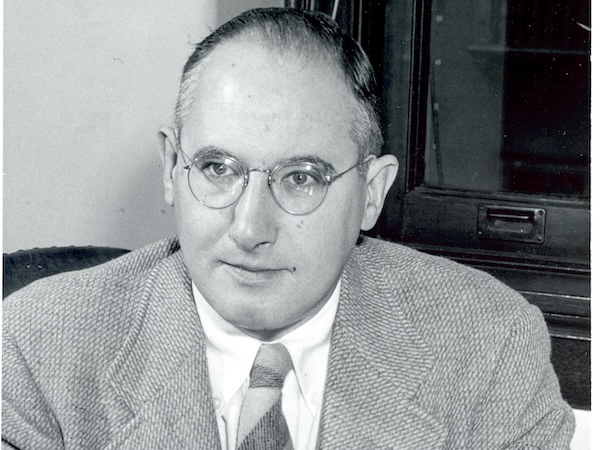
– Excerpted from Robert Belknap’s tribute to Simmons in Harriman’s 60th Anniversary
Ernest J. Simmons was in his early forties when Columbia brought him from Cornell to reinvigorate its Russian Department and elaborate on an idea he had conceived at Cornell, an Intensive Program in Soviet Civilization. He bore a rich body of intellectual baggage. As an undergraduate and then a graduate student at Harvard, he had studied English literature with George Lyman Kittredge, Livingston Lowes, and other legendary figures, about whom he would sometimes reminisce. He had learned Russian and wrote a dissertation on English influences on Russian lyrics of the early nineteenth century, and spent much of 1928 in Russia at one of the most exciting moments in its history, culturally and politically. He taught at Harvard, and then at Cornell, where he built a strong department and weathered the political fallout from Soviet involvement in the early days of the Cold War. He had the ideal background for what Columbia needed.
Simmons worked with Geroid Robinson, Philip Mosely, Abram Bergson, and John Hazard to equip Columbia to function in the bi-polar world that emerged at the end of World War II. The Rockefeller Foundation, and later the Carnegie and other foundations helped them to invent a new kind of educational enterprise, the area studies institute. The Russian Institute, founded at the end of the forties, rested on the assumption that the United States needed experts trained at the graduate level in the existing specialties, but able to deal with the very different and sometimes weird situations in the Soviet Union.
He had moved intellectually to the point where he was using literature as an instrument for understanding society. He edited a book called Through the Glass of Soviet Literature. His own books on Dostoevsky, Tolstoy, and Chekhov were impressive gatherings of what was known about those authors at that time, but had none of the intense and often rarified attention to the text which the New Critics in America and the Russian and other Slavic formalists were making exciting in Europe. Simmons had brought Leon Stilman from Cornell with him as a remarkably talented language teacher, and brought Roman Jakobson from Prague, the most brilliant and most difficult Slavist of his generation. He also produced a group of graduate students, Rufus Mathewson, Richard Gregg, Franklin Reeve, Robert Maguire, Richard Gustafson, and myself, all of whom considered his approach to literature oldfashioned, and even Soviet, not politically, but literarily. Jakobson soon defected to Harvard, but the others opposed Simmons on his own ground, and his response was the same in every case, and was typical of the man. He hired us all.