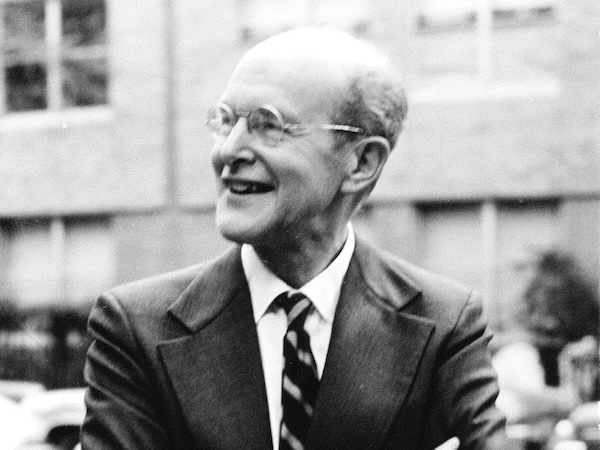
– Excerpted from Peter Juviler’s tribute to John Hazard in Harriman’s 60th Anniversary book
John Newbold Hazard, Nash Professor of Law, brought an impressive background (in Harvard and Chicago University Law Schools, and public policy — helping administer Lend-Lease during World War II). Before his doctoral studies in Chicago, John was sponsored as a Traveling Fellow by the Institute of Current World Affairs to spend the years ’34 –’37 earning the Certificate of the Moscow Juridical Institute (predecessor of the Law Faculty of Moscow University where I eventually spent three semesters, 1958 – 59 and 1964). As they say—that was “ne sluchaino”—no coincidence. For I had learned from John Hazard how important rule through law could be (as opposed to rule of law) under Soviet totalitarianism. Sure, John Hazard was not a political scientist. Later when I started and co-taught a course in political movements, at Barnard, John asked me, “political movements—what are they?” Good question, the experts are still juggling answers to it.
I asked someone who knew John Hazard to characterize him.” Genial,” she volunteered. And indeed he was, deeply so. He and his wife Susan Hazard would invite former students and their Soviet colleagues home to enjoy some warm and welcome hospitality. John and Susan loved music. And I think in 1992, both of them came to and warmly participated in a fund raiser for the now defunct One Hundred Street Concert Association. During his last months, laid out at home with a fatal cancer, John remained in touch with his friends and former students, some of whom managed to arrange to transfer his formidable collection of books and other research materials to Columbia University. Yes, John had at home a veritable research library of his own. He wasted no time, he once explained to me. Up early, he had breakfasted and read the paper and was ready to turn to work by 8 am. Genial, yes, but self-disciplined and a productive scholar, editor or co-editor of important collections of Soviet legal materials, and author of many books on the Soviet system of law and system of government. He loved to travel, and to lecture abroad and aboard a floating university with Susan as librarian. Since his time, area studies have both come under challenge, and been revitalized at the successor Harriman Institute. But the combination of both disciplinary expertise and interdisciplinary area studies carries on.