A Harriman postdoctoral alumna on how the Trump administration’s budget cuts impede the democracy-building efforts at Freedom House.
Yana Gorokhovskaia (Postdoctoral Research Scholar in Russian Studies 2016–19) joined Freedom House in 2021 just as the independent watchdog organization had released a groundbreaking report on transnational repression. Three years earlier, the Saudi government had brutally murdered dissident journalist Jamal Khashoggi at the Saudi consulate in Istanbul. Cases like that were on the rise across the globe and this was the first-ever global study examining how governments used violence and intimidation to silence critics in exile. The issue, part of Gorokhovskaia’s portfolio in her new job, quickly went “from an academic niche to a topic of conversation at the UN, U.S. Congress, European Parliament, and G7,” she said. Now, when those bodies call for expert testimony, Gorokhovskaia is often a main witness, laying out details from her Freedom House reports and from the organization’s database documenting over 1,200 acts of transnational repression since 2014 in 48 countries—including major offenders China, Turkey, and Russia.
“The issue has a lot of resonance,” said Gorokhovskaia. “Because the space for activism inside authoritarian countries is closing, dissidents are fleeing abroad where they continue to be targeted.” That endangers both the dissidents “and the sovereignty of the democratic country where they have settled… It’s the rare problem that crosses human rights and national security,” she said.
Now, since the Trump administration’s drastic cuts to programs supporting human rights and democracy building, it also is a problem that organizations like Freedom House have fewer resources to fight. Freedom House was hit particularly hard—the research department, where Gorokhovskaia is director of strategy and design, lost 16 of its 24 staff members. And a new program aimed at building more awareness and protections for targeted exiles had to be canceled after just four months.
Gorokhovskaia, who immigrated from Russia to Canada as a child in 1995, focused her doctoral studies on Russian electoral politics. She came to the Harriman Institute as a postdoctoral research fellow in 2016, as Russia was growing increasingly repressive. Yet opposition efforts there—and in other authoritarian states—continued.
“Even today, when I interview dissidents working from exile or those still in their home countries, I’m always surprised by how open they are about their activities and also how aware they are of the risks,” she said.
In addition to her work on transnational repression, Gorokhovskaia oversees Freedom in the World, the Freedom House flagship report issued annually since 1973. The report identities each of the world’s 195 countries as “free,” “partly free,” or “not free.” Those shorthand ratings are based on detailed analysis of each country, with previous editions giving a detailed narrative explaining each rating.
But when the next edition of Freedom in the World appears in March 2026, it will be much shorter. “We had to scale [it] down,” said Gorokhovskaia, due to budget and staffing cuts. Instead of the traditional narrative, some country reports will be reduced to ratings only. An end result, she believes, is “that there will simply be less information available on what authoritarian government are doing to their people.”◆
Gorokhovskaia’s postdoctoral position was sponsored by a grant from Carnegie Corporation of New York.
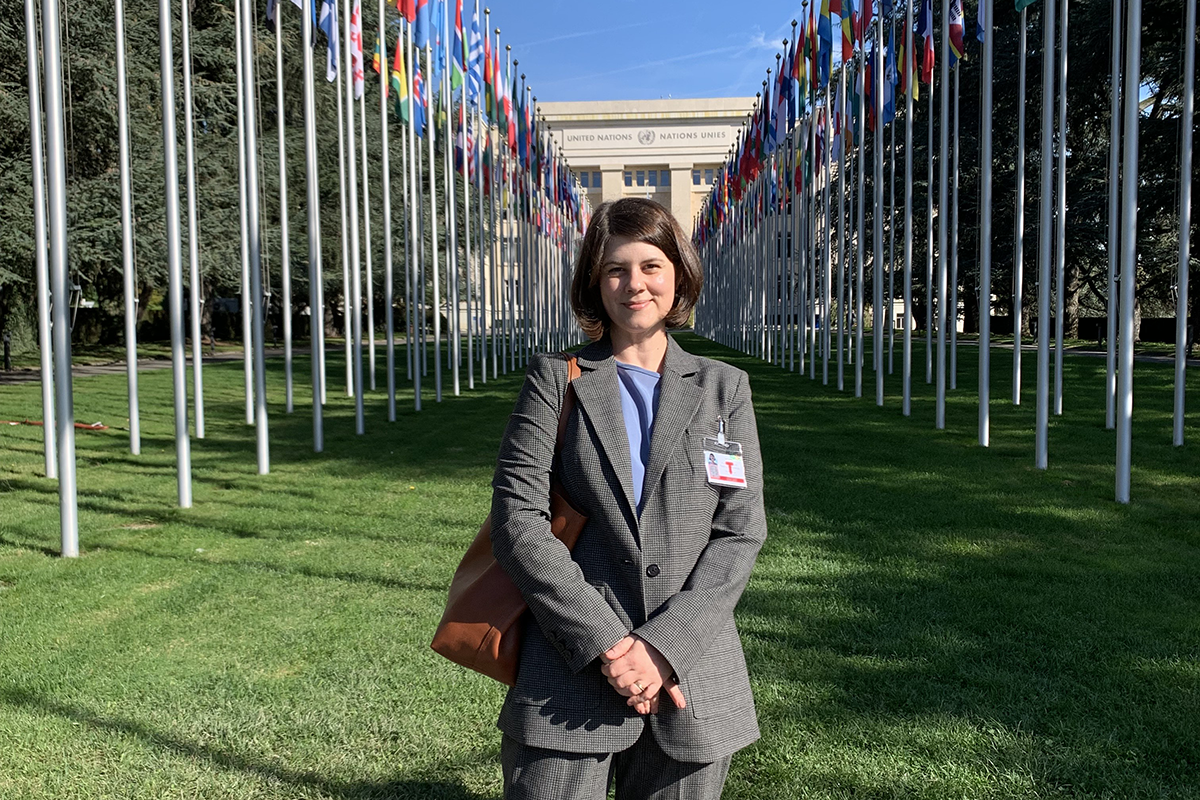
Featured photo: Outside United Nations offices in Geneva. Photo courtesy of Yana Gorokhovskaia