A millennial reflects on her native country’s long struggle with the ghost of Stalin.
In November 2024, I was in Florida celebrating Thanksgiving when images from my hometown, Tbilisi, Georgia, flooded my phone: grainy live footage of riot police storming opposition offices, dragging politicians out in handcuffs, beating young protesters with batons. Thousands of miles away, I froze, eyes locked on the screen, dreading the moment I might recognize a familiar face—a school friend, a cousin, an old neighbor—brutalized for daring to speak out against the government. It was the third day of large-scale demonstrations in Georgia, protesting the government’s decision to stall the country’s long-standing bid for European Union membership.
What none of us fully grasped at the time was that, while this renewed wave of demonstrations would surge and recede, the resistance movement led by a new generation of Georgians—Gen Z—would endure months later.
As a geopolitical risk analyst focused on the South Caucasus, and a former U.S. State Department project implementer in the Eurasian region, I’ve spent years tracing the emerging trends and aftershocks of authoritarianism across the post-Soviet space. I reflected on the trauma among my generation of Georgians in my debut monograph, Stalin’s Millennials, which I began working on as a graduate student at the Harriman Institute and published just before Russia’s 2022 full-scale invasion of Ukraine. It was meant as a closing chapter on the legacy of the Georgian-born dictator for those of us who came of age in the ruins and ashes of a failed Soviet experiment. But, unfortunately, the legacies I believed I was analyzing in retrospect have since returned as contemporary issues, and with renewed force. Now, once again, the authoritarian tendencies of the Stalin era are playing out in real time—all over my homeland.
Georgia is a country of deep contradictions: layered, proud, weary, defiant. Our landscapes are breathtaking, our poetry ancient, our resilience, by many accounts, legendary. But today, that pride contends with a deeper fear: that we are slipping backward. Or worse, that we may no longer deserve the democratic promise we once pursued with such conviction. And yet, even in that fear, I see something rekindled. I hear it in the chants that still echo through Tbilisi’s streets. I see it in the faces of Gen Z protestors who are neither burdened by the compromises of the past nor beholden to its silences. This new generation, in many ways braver than my own, is rising. They are louder. They are clearer. And, thankfully, their faith is not broken.
While the immediate catalyst for the winter 2024 protests was the government’s decision to stall EU membership—a move that felt like betrayal to many Georgians, more than 80 percent of whom support the country’s European integration, according to recent polls—the truth is that Prime Minister Irakli Kobakhidze’s announcement was merely the spark that relit a long-smoldering fire. The ruling Georgian Dream party had adopted an increasingly pro-Kremlin narrative several years earlier, and Georgia’s democracy continued a steady backslide into autocracy. In late 2024, many independent international observers concluded that the October parliamentary elections failed to meet international standards, casting serious doubt on the legitimacy of the results. Numerous ballots had been cast under pressure and even direct threat, some allegedly bought. In a nationwide standoff, opposition parties boycotted the new parliament. Georgian Dream, however, moved swiftly to consolidate power, passing a suite of laws that looked far less European and increasingly authoritarian.
One of the most consequential was the so-called “foreign agent law”—modeled after contentious legislation Russia had passed more than a decade earlier to discredit and dismantle civil society. The Georgian government first introduced the draft bill in March 2023, sparking major protests in Tbilisi, alongside sharp warnings from Washington and Brussels that its passage would strain ties with Western allies and derail Georgia’s EU aspirations. Although the Georgian Dream-led parliament briefly withdrew the bill, it was reintroduced a year later and officially implemented on August 1, 2024, just months before the October parliamentary elections. This triggered a fresh wave of demonstrations, initially led by students and soon joined by parents, teachers, doctors, pensioners, and artists—many of whom had lived through Georgia’s painful transitions and recognized exactly what was at stake. They were not simply opposing a law; they were rejecting what was widely viewed as a dangerous pivot: “Never Back to the USSR,” they chanted. Public outrage only intensified after November 28 of the same year, when the Georgian prime minister announced the suspension of EU accession negotiations, prompting nationwide demonstrations.
Watching from my hotel room in Florida, the contrast felt surreal: palm trees swayed outside my window, while tear gas drifted across Rustaveli Avenue on my screen.
Georgians had similar experiences even before the Soviet Union’s collapse, when they began taking to the streets to assert the country’s independence from Russian domination—most notably on April 9, 1989, when Soviet troops crushed a peaceful pro-independence demonstration. But that time, it was not a struggle of us versus them—it was Georgians against Georgians. Our country was beginning to resemble what it had spent decades striving to avoid: a nation polarized, divided at its core.
To understand how the country reached this point, we must look back. My generation still remembers the promise of Georgia’s Rose Revolution in November 2003—one of the most dramatic and hopeful chapters of the post-Cold War period. The Revolution was a peaceful uprising that toppled Eduard Shevardnadze, Georgia’s second president and former Soviet foreign minister, in response to widespread corruption, economic stagnation, and alleged election fraud. It felt like a moment of collective awakening: streets filled with citizens demanding change, a nation daring to believe in the possibility of democratic renewal. These peaceful protests succeeded, leading to Shevardnadze’s resignation and the arrival of young, energetic Mikheil Saakashvili, whom many of us trusted to guide the country into a new era of reform.
In 2004, while Western leaders lauded Georgia as a democratic trailblazer of the Eurasian region—a poster child for post-Soviet transformation—I had just moved to New York from Moscow, where I had lived with my parents for nearly a decade after the civil war erupted in Georgia in the early 1990s.
When I told new American friends that I was originally from Georgia, this was usually met with one of two reactions: “Isn’t that where Stalin was from?” or “Didn’t your country just have a color revolution?” Both were delivered with genuine curiosity about, sometimes even admiration for, Georgia’s bold pivot toward the West and away from the long shadow of its Soviet past. Yet that sense of hope, so vivid in our memory, would prove fleeting.
Several years later, in August 2008, Russia invaded Georgia. I was barely in my twenties, working as a journalist covering the United Nations for Novoye Russkoye Slovo (The New Russian Word), a Russian-American newspaper headquartered in the Empire State Building. The two countries that shaped me were suddenly at war, and I was expected to report, filing daily and sometimes even hourly dispatches from the United Nations. But how do you remain neutral when Russian bombs are falling minutes from your childhood home?
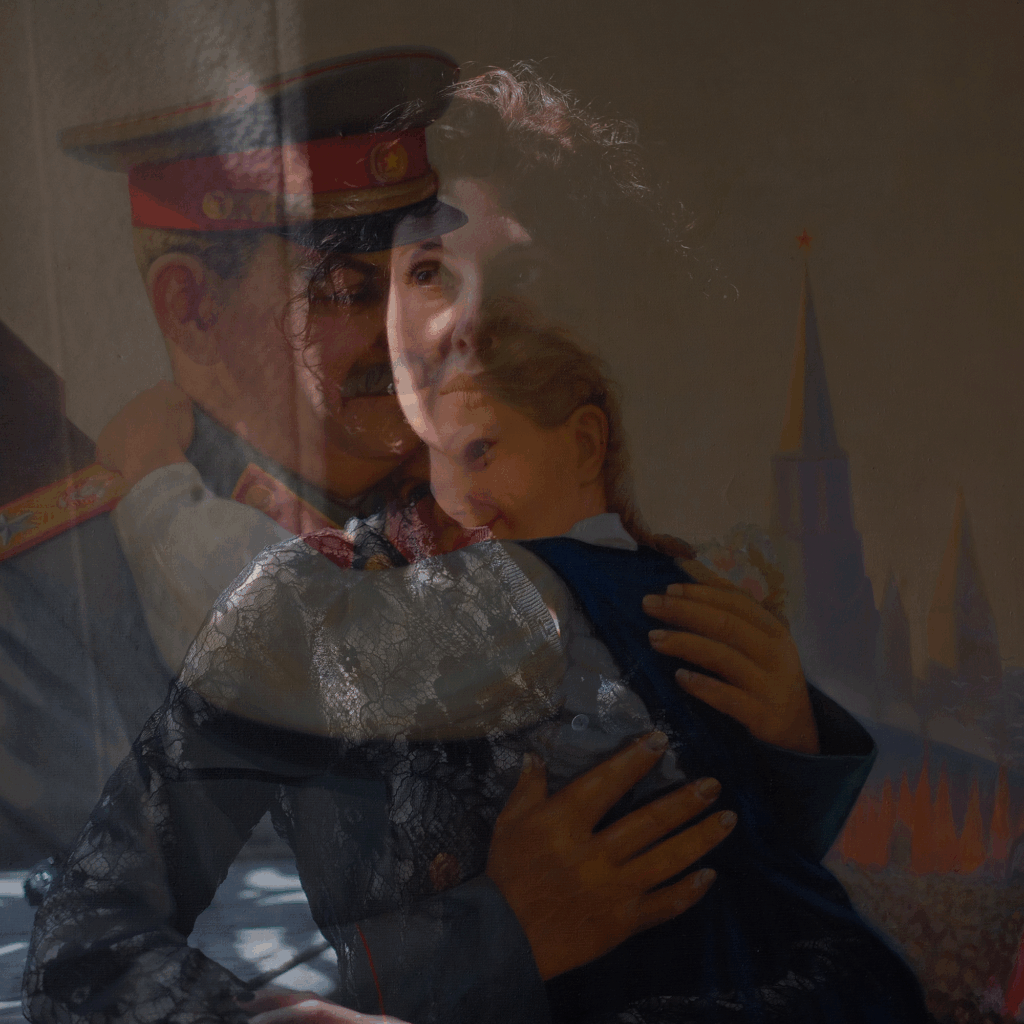
Japaridze’s reflection in the glass frame of the oil painting “Stalin and a Girl” at the Joseph Stalin Museum in Gori. Photograph by Zaqaria Chelidze
Georgia’s political unraveling has been gradual. And it has a lot to do with disinformation. First from the Kremlin, which honed its tactics during Soviet times and ramped them up after the Soviet collapse. And then from Georgia’s own leaders. Even Saakashvili, after losing popularity in the later years of his rule, used disinformation tactics to frame narratives and sway public opinion.
And then Georgian Dream came to power in October 2012. The party’s founder, Bidzina Ivanishvili—who had reportedly made his fortune in 1990s Russia—wanted to consolidate power and drew from Moscow’s rhetorical arsenal, weaving key elements of the Kremlin playbook into Georgian Dream’s political strategy.
The disinformation only intensified after Russia’s full-scale invasion of Ukraine in 2022. Echoing the Kremlin’s talking points, Georgian Dream officials portrayed the war not as Russian aggression, but as a cautionary tale—a warning to small nations of the perils of moving too close to Europe, of compromising sovereignty and cultural identity, and of becoming little more than cogs in the EU’s machine. Against this backdrop, Georgian Dream presented itself as the pragmatic guarantor of peace, and it reframed Russia—the country that invaded Georgia in 2008 and still occupied 20 percent of its territory—not as the threat, but a “complicated neighbor” that shouldn’t be provoked.
It was a shrewd, chilling inversion that tilted Georgia’s political compass and sowed discord among the population. Fear of war, even when abstract or carefully manufactured, has a way of sinking deep in a nation that still remembers the sound of bombardment, the dislocation of exile, the quiet permanence of occupation. And so, dissent came to be defined as subversion, and protest turned into a source of menace.
Western media coverage often reduces Georgia’s polarization to a simple binary: pro-West versus pro-Kremlin, liberal versus conservative. But in reality, the fractures run deeper, cutting across families, friendships, and entire communities. At the heart of the divide lies a very personal debate over Georgia’s cultural and historical identity, rooted in a long tradition of resisting foreign domination—should Georgia join Europe, try to mend ties with Russia, or remain a nation independent from the influence of any major power? How can Georgia’s traditional Orthodox Christian values coexist with the EU’s accession requirements on LGBTQ+ rights and gender equality? I have watched people who regularly broke bread together unfollow or outright block each other on social media over the question of whether Georgia’s future lies within Europe, alongside Russia, or as an independent, sovereign nation free from reliance on any major power in order to preserve its cultural values and traditions. By 2024, personal rifts had converged with a national crisis, shaping not just how Georgians lived with one another but also how the world tried to make sense of our politics.
As a student at the Harriman Institute, I had tried to make sense of Stalin’s legacy not only as a scholar, but as someone indelibly shaped by it. My graduate research took me repeatedly to Stalin’s hometown of Gori, but the “Stalin question” wasn’t just academic. It had begun much earlier, around my family’s dinner table, in the silences of daily life. Even in the late Soviet years, the stories of Stalin’s purges were told in whispers behind locked doors. Later, while working on Stalin’s Millennials, I understood that what kept those memories hidden was not just fear, but also the dread some Georgians felt of having been complicit in these atrocities as mere bystanders, because many had chosen the silence over change. The terror was never just personal, but collective, and it lingered.
And that’s why the current moment matters. Not just because the West is watching, but because finally, Georgians are watching themselves, unflinchingly. Georgia’s Gen Z is writing a new chapter—not just of politics, but of memory. Of reclamation. And this fight, as ever, is ours. International support matters—diplomatic pressure, financial aid, visibility—but lasting change must come from within, from Georgians rejecting the very silence and fear that has kept the ghost of Stalin alive.◆
Tinatin Japaridze is a 2019 alumna of the Harriman Institute. She is Director of Geopolitics at Anadyr Horizon and used to lead Eurasia Group’s South Caucasus coverage, contributing to the firm’s analysis of the Russia-Ukraine war and regional technology policy. She is a former United Nations Bureau Chief for Eastern European media outlets and author of Stalin’s Millennials: Nostalgia, Trauma, and Nationalism (Bloomsbury Publishing, 2022).
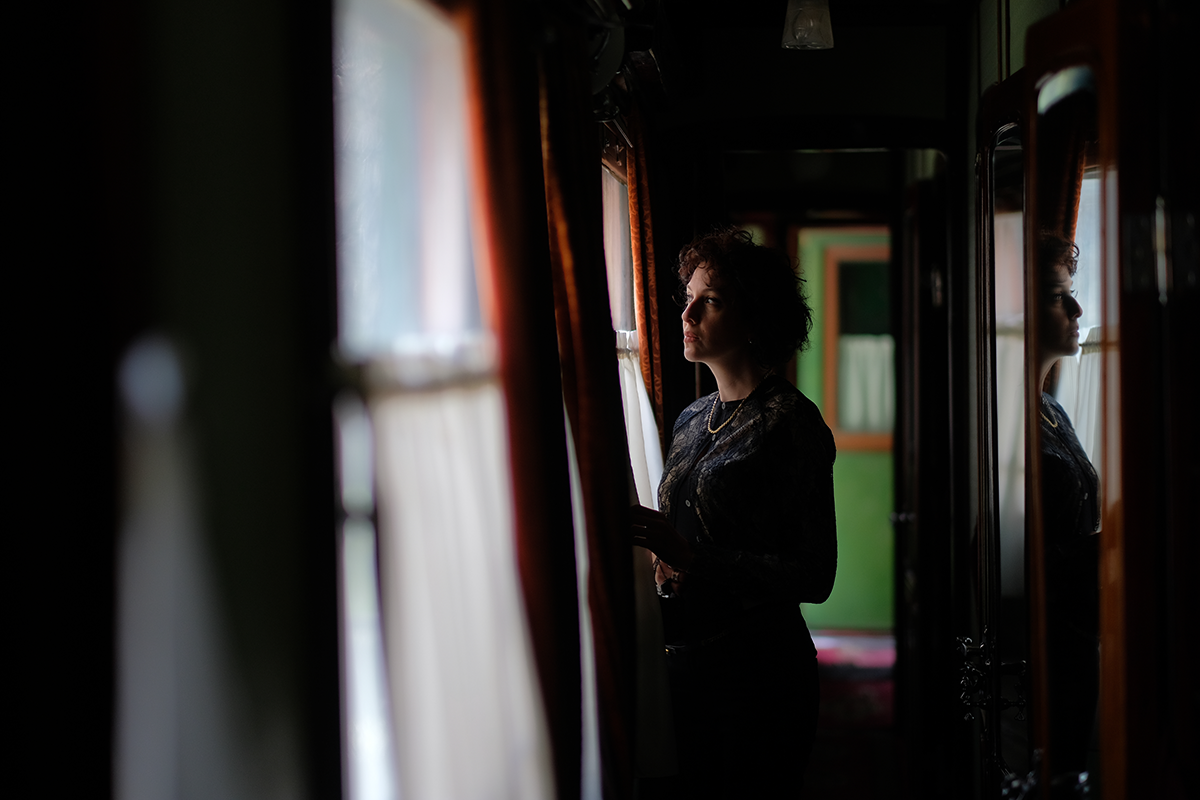
Featured photo: Japaridze in Stalin’s personal armored train carriage in Gori, used to transport the Soviet leader to the Tehran, Yalta, and Potsdam conferences. Photograph by Zaqaria Chelidze