A political scientist reflects on the rise of participatory democracy in her homeland.
“I’ll be here all day, don’t call me!” my 30-year-old sister texted me casually from an anti-government protest in Kyiv, one of many sparked by the Ukrainian parliament’s July 2025 decision to strip key anti-corruption bodies of their independence. Large crowds, predominantly young people, were protesting all over Ukraine against the passing of a highly controversial bill (No. 12414) designed to significantly limit the powers of the National Anti-Corruption Bureau of Ukraine and the Specialized Anti-Corruption Prosecutor’s Office. Pro-democratic reforms were at stake, and millennials did not like it.
My sister was in the center of Kyiv, surrounded by thousands of like-minded people holding witty cardboard signs, ranging from moderate slogans like “Democracy? Haven’t heard of it” and “I don’t need a system that works against me” to “Don’t touch my sup” (a pun referring to the Anti-Corruption Prosecutor’s Office) and “You are out of your mind.” Some of the messages resorted to just straight-up cursing. One sign even featured a caricature depicting the life cycle of a corrupt politician, who oddly resembled a head louse. Despite the very real possibility of a Russian air strike on such a massive crowd—and the potential, though unlikely, risk of the Ukrainian government turning against the protestors—I somehow knew she was going to be fine.
Still, I decided to text back:
“Wait, what exactly are you doing?”
“Just chanting ‘Shame!,’ as usual.”
As usual, it was. While shouting “Shame!” in a historic downtown might resemble a scene from Game of Thrones, for most Ukrainians “Han’ba!” (the Ukrainian word for “shame”) had long been a favorite way to express opposition to those in power. What was unusual was that, for the first time in Ukrainian history, it seemed to be working quickly and effectively. Just nine days after the protests began, a major Ukrainian online news site, Ukrainska Pravda, reported that the demonstrations had “won and ended.” The president had deleted from his website the bill he had previously signed and was now pretending the whole thing never happened. The parliament passed a bill canceling the latest amendments. The “cardboard revolution,” as the series of protests came to be known, was over.
The success of the July protests was duly attributed to the long history (and experience that comes from it) of mass mobilization in Ukraine. This summer reminded many Ukrainians of the Orange Revolution, a much longer, yet peaceful protest that brought along the wave of democratization in the early 2000s. But the non-partisan nature of the protests, the grassroots character, and the overall youth of the protesters resembled the structure of the Euromaidan demonstrations in 2014, when after four months and 108 deaths protesters managed to oust Ukraine’s pro-Russian leader Viktor Yanukovych.
A couple of weeks after the protests I attended a conference in Europe and had the chance to see my sister in person. The scope of problems we discussed had returned to wartime “normal.” We talked about all our male relatives currently serving in the military, and, thankfully, in good health; about our childhood neighborhood in Kyiv, which survived a massive airstrike; and about our parents’ dacha (summer house), which was now uncomfortably close to the frontline, so our family would have to wait to fix that leaking roof. The topic of democracy, however, wasn’t on our agenda. Unlike everything else at our kitchen table, it didn’t feel to be under imminent threat. The protests ended with success, and the ever-present concern about corruption was pushed to the background.
This lack of concern about democratic backsliding stands in stark contrast to nearly every conversation I now have with my friends in the United States.
In many part of the world, the erosion of democracy has become a painful reality, the most salient agenda item with very tangible political consequences. In theory, war-torn Ukraine should be a perfect breeding ground for authoritarian consolidation: canceled (or rather, never scheduled) elections, lack of civilian control over the military, and restrictions on civil liberties form a textbook list of preconditions for democratic decline. And yet, the recent protests, democratic reforms, and government efforts to stay transparent and accountable suggest that democratic institutions in Ukraine stand tall and resilient.
This counterintuitive puzzle raises a simple question: What are we missing here?
Scrolling through my news feed in search of answers, I stumbled across project updates from e-dem.ua, Ukraine’s online platform for electronic democracy, run by the Eastern Europe Foundation in partnership with the Ministry of Digital Transformation of Ukraine and funded by Switzerland. Amid the endless stream of local petitions and participatory budget projects, a few titles stood out: “Ban on feeding pigeons” in Kropyvnytski, “Mowing ragweed” in Lutsk, “Sand on sidewalks” in Drohobych. Why did people care about such minor infrastructure problems when there’s a full-scale war raging the country? Why did it matter, if pigeons, ragweed, and even freshly built sidewalks could be destroyed by the next Russian missile?
And then it hit me: the places where these local petitioners were from were the very same places that hosted the “cardboard” protests in July—cities like Kropyvnytski, Lutsk, and Drohobych. The people who cared about animal welfare, environmental protection, and public safety were the same citizens who cared about the survival of democracy. Their activism suggested that people refused to let war swallow local concerns. It wasn’t that communities were “thriving” in the usual sense, but that they were holding onto the habits and practices that would make thriving possible once the war ended: staying organized, finding common ground combined with creative solutions, and refusing to give up on civic life.
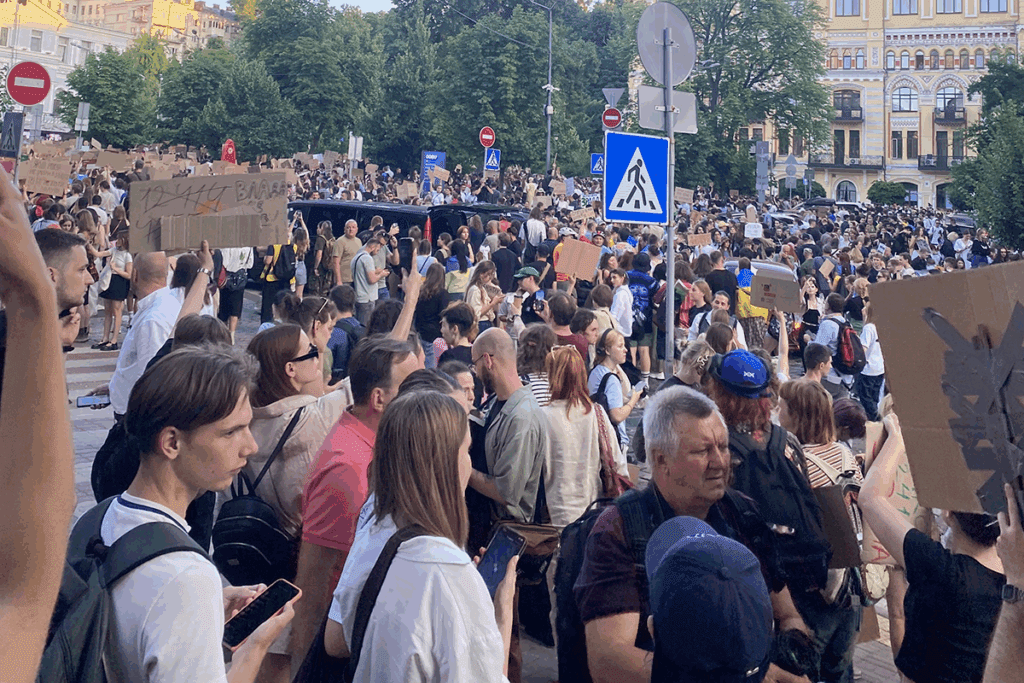
Anti-corruption protest in Kyiv, July 2025. Photograph by Khrystyna Vlasenko
That’s the message in a solid body of recent studies on comparative politics—an area of scholarship I am trying to contribute to as a political scientist—suggesting that places where residents actively participate in democratic initiatives also tend to be more resilient during wartime. In 2022, videos spread across the internet of Ukrainian farmers towing away Russian tanks. But the events preceding the full-scale invasion—such as the Orange Revolution and Euromaidan, which empowered the tractor drivers to feel that they could (and must!) change the course of war—stayed outside the camera frame.
After signing the Association Agreement with the European Union (EU) in 2014, Ukrainian leaders started a series of reforms, designed to facilitate further EU integration of Ukraine. One of the key reforms, implemented from 2015 to 2020, focused on decentralizing local governance. Until then, Ukraine had maintained the topdown Soviet-style system of highly centralized oversight of the local decision-making process. This discouraged grassroots organization and made it difficult for local communities invaded by Russia in 2014 to react coherently to the invasion. The decentralization reforms gave hromadas (amalgamated communities that consist of several villages and towns) new authority over tax collection, budget planning, public goods provision, and more, marking a radical break from Ukraine’s Soviet past. By the time Russia invaded Ukraine in 2022, many communities already knew how to solve local issues without awaiting directives from Kyiv. This experience contributed greatly to Ukraine’s unexpected resilience in the face of Russia’s invading forces in 2022; resistance, resilience, and even rebuilding quickly came to be treated as just another set of “local issues” to be managed collectively.
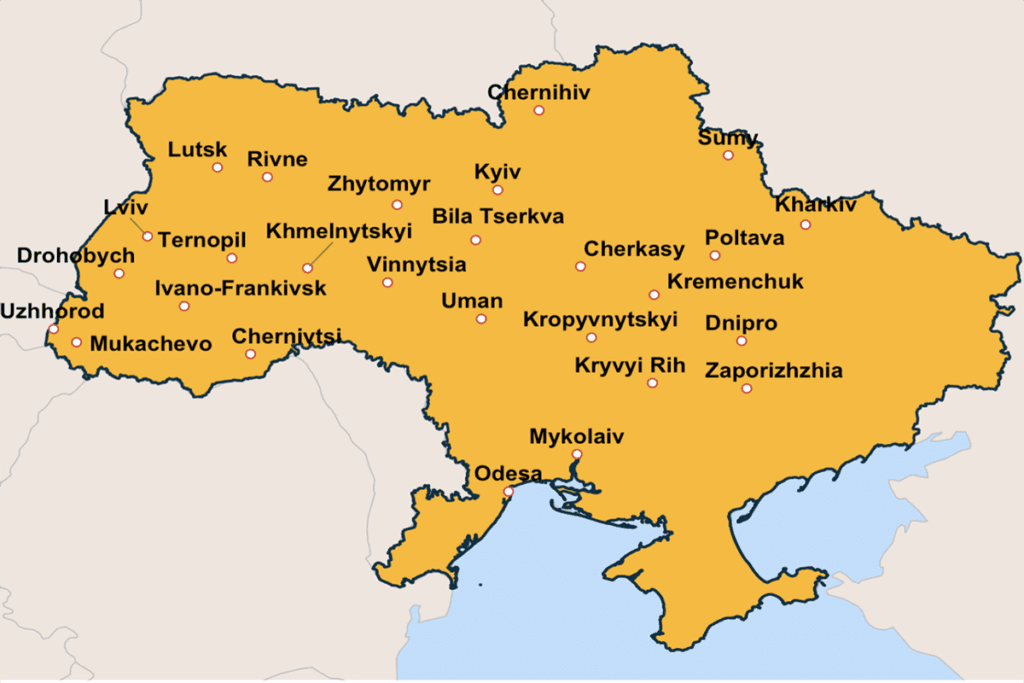
Locations of the anti-corruption protests in Ukraine, also known as Cardboard Maidan, from July 22 to July 31, 2025. Map created by the author
The case of Sofiivska hromada, an area consisting of nine villages located in the Zaporizhzhia region, is a good example of this. It was one of the first places occupied by the Russian army on February 26, 2022. Its 29-year-old mayor, Stanislav Zakarevych—elected right before the full-scale invasion—decided to resist. Before the war, Zakharevych had focused on small-scale infrastructure projects, such as renovating a local school and building a new medical center. After the invasion, he rejected every offer to collaborate with Russian forces and instead organized food and medicine deliveries while securing evacuation routes for residents. These activities led to his imprisonment in unnamed torture basements in the occupied cities of Prymorsk and Berdiansk, where he was held for 34 days. Meanwhile, Zakharevych’s former constituents evacuated to the city of Zaporizhzhia (still under Ukrainian control) and continued self-organizing, volunteering, and maintaining community ties despite the loss of their homes. Zakharevych escaped by pretending to agree to the occupiers’ demand to collect data on residents eligible to participate in a staged referendum on joining the Russian Federation. He joined his constituents in evacuation and continued helping internally displaced residents of Sofiivska hromada.
What fascinates me in this story is the unanimous dedication of residents and elites toward resistance. Even after Sofiivska hromada lost its territory, it did not cease to exist, demonstrating that, once representative democracy takes root, the loss of territory does not necessarily erase local representation. In Ukraine’s experience, at least, democracy can endure even when war threatens territorial integrity.
Other Ukrainian communities such as Byshiv, near Kyiv, have demonstrated their resilience through their ability to think of creative solutions in the face of massive destruction. Byshiv became the last line of defense as Russian forces advanced toward the capital in March 2022. By the time the frontline shifted eastward, the Russians had destroyed many of Byshiv’s vital facilities, with many buildings, including a daycare facility, needing reconstruction. For local authorities, the daycare was last on the list. But that changed after mounting pressure from distraught parents. The authorities, who lacked the funds to do it on their own, turned to an unlikely sponsor: the Surkis brothers, notorious Ukrainian oligarchs known for their criminal records and corruption scandals. The daycare was promptly rebuilt. While it remains unclear what motivated the mayor to ask the oligarchs for help, representative democracy once again prevailed by ensuring the delivery of public goods during crisis. Interestingly, since the oligarchs contributed to the provision of public goods rather than offering private perks to local authorities, they were unable to undermine democratic processes in the community. At least, this has been the case so far.
Byshiv is not the only place using innovative methods to rebuild during wartime. And the money for reconstruction doesn’t only come from oligarchs—local communities have turned to foreign donors, both public and private, for help. As of now, the official Ukrainian decentralization website, run by the state, decentralization.gov.ua, lists 2,094 partnerships between Ukrainian territorial communities and foreign regions, cities, towns, and even small villages. This subnational support plays an essential role not only in ensuring that schools and hospitals are rebuilt in a timely manner but also in enabling foreign partners to help safeguard Ukraine’s democratic institutions.
These partnerships do not come without cost. Hromadas must compete for the most lucrative deals. And the number of partnerships each community secures varies greatly. That’s because competing for foreign partners requires substantial upfront investment—hiring PR and fundraising professionals, English lessons for administrative staff, networking—and many Ukrainian communities cannot afford it. Ironically, this means that only the wealthiest and most motivated can earn the title of “most democratic.” As elsewhere in the world, democracy is closely tied to the level of local economic development.
This is precisely why, for democracy in Ukraine to survive the war, the active involvement of zealous citizens is not enough. The danger to democracy may not have seemed pressing enough for my sister and me to ponder when we met last summer, yet its endurance depends on more than the zeal of its defenders. As global interest in Ukraine gradually fades, democracy risks becoming underfunded. While Ukrainians are doing everything they can to keep the world’s attention, international donors, from large organizations to private individuals, might ask themselves what risk they run if democracy in Ukraine fails. Fortunately, for now, Ukrainians themselves remain undeterred.
In wartime, resilience and rebuilding go hand in hand. Both require immense mobilization. Both depend on close interaction between residents and elites. Both help democracy survive and thrive, even when it seems pushed to the back burner. Our task as an international community is to make sure we keep watching it closely and promoting the Ukrainian cause, even when democracy seems safe, unlike everything else.
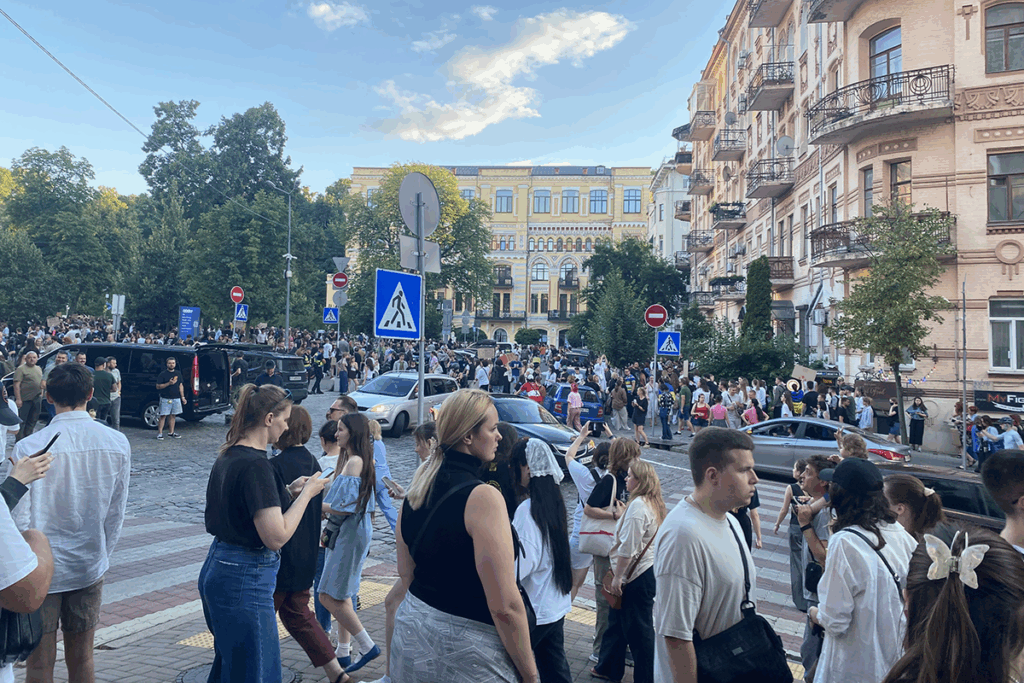
Young people arriving to an anti-corruption protest in Kyiv, July 2025. Photograph by Khrystyna Vlasenko
While procrastinating instead of finishing this article, I stumbled upon an Instagram post from my sister: “It would be the best summer of my life if no one tried to kill me.” The post was accompanied by a mix of pictures—scenes of a massive drone attack on Kyiv, her birthday, anti-corruption protests, and picnics with friends. Just like Yossarian in Catch-22, my sister is caught in a limbo where the people shooting at everyone are, by definition, shooting at her too. What is different is that unlike Yossarian, my sister is not trying to escape. Like many Ukrainians before her, she is ready to fight back, if not on the battlefield, then on public squares and by participating in grassroots efforts and creative local solutions that ensure the resilience of Ukrainian democratic institutions. This is how democracy can stay strong: through people willing to fight for it, against all odds.◆
Anastasiia Vlasenko is the Harriman Institute’s Petro Jacyk Postdoctoral Research Scholar in Ukrainian Studies.
Featured photo: Young man holding a paddle board with a “hands off SUP” sign (SUP refers to both paddle board and the acronym for Specialized Anti-Corruption Prosecutor’s Office) during an anti-corruption protest in Kyiv in July 2025. Photograph by Khrystyna Vlasenko