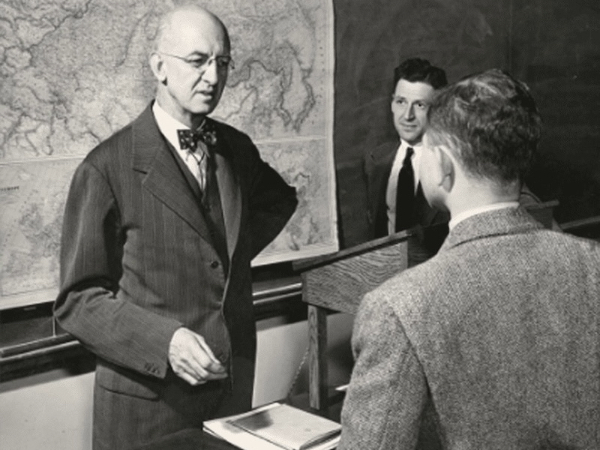
Excerpted from Marshall Shulman’s tribute to Geroid T. Robinson for Harriman’s 60th Anniversary.
Who, on meeting Geroid Robinson walking on Riverside Drive, could mistake him for any other? This tall, courtly man, this gentleman, patrician in his bearing, in his dignity, his dress—the weskit, the ribboned glasses, the cane—his was the day when individuality was expressed in fastidiousness of dress—his features like an eagle, his lips characteristically pursed in some wry and acerb comment on the events of the day—this was his outward appearance. In a word: formidable. More accurately, formidable, in the French sense.
But within? His reserve was a garment of protection; it covered a shy warmth. He had humor, a wry, finely wrought humor, sometimes directed against himself with a hopeless shrug, sometimes almost indistinguishable from despair.
At times there were glimpses of anguish, of some inner frenzy at the chasm between vision and realization, of impatient anger at the elusiveness of the perfection he demanded, most of all from himself.
A workman in Connecticut, who planted trees and did carpentry for GTR at the country home he loved, said: “he was a man who always insisted that things be done exactly right”—and several generations of students would say: Amen.
These generations of students were the heritage he left. They were his vision, his creativity, his fulfillment. Gerry was a man whose comments on a student’s paper were often longer than the paper itself. A request from a student for advice has been known to elicit a forty-page reply, thick with bibliographic leads. Gerry’s bibliographic card-file was his treasure, and he relished having his students eagerly cluster around it, in the hallway of the old Institute building.
He was a bearer of tradition—the tradition of high scholarship, which was his calling, his priesthood, and he served it with total and uncompromising dedication. To this restless age, his life speaks of values to be cherished and preserved—of tolerance and civility, not as mannered amenities, but as heart and soul of the democratic process.
He has left his stamp upon us. He will be remembered as a man who strove mightily, nobly, to realize his vision of perfection, and in that struggle he found both despair and happiness.
The words of Camus apply: “The struggle itself toward the heights is enough to fill a man’s heart.”
Geroid Tanquary Robinson was an American historian of Russia and the founding director of the Russian Institute, now the Harriman Institute. A Stanford graduate, he began his career in journalism before earning his doctorate in history at Columbia in 1930. His research in the Soviet Union during the 1920s produced his only book Rural Russia under the Old Regime (1932), a study of the Russian peasantry. During World War II, he headed the USSR Division, Research and Analysis Branch. After the war he became a central figure in the rapidly developing field of Russian studies. He directed the Russian Institute from 1946 to 1951 and became Columbia’s Seth Low Professor of History in 1950, later retiring in 1960. He passed away in 1971.