During the early years of the Cold War, the Russian Institute found itself in a politically delicate situation. Its founding mission promoted the deep study of contemporary Soviet Russia. However, the intense anticommunist paranoia during McCarthyism in the late 1940s treated the faculty’s expertise and professional associations as possible evidence of ideological sympathy or political disloyalty. Several of the Institute’s founding members became targets of Senator Joseph McCarthy’s campaign.
Ernest J. Simmons, professor of Russian literature and a fixture at the Russian Institute, was publicly vilified over his editorial oversight of “USSR: A Concise Handbook,” a compilation of scholarly articles on Soviet life. In a hearing characteristic of the era, McCarthy condemned the handbook as “complete Communist propaganda” and insufficiently critical of the Soviet Union, with some witnesses claiming that Simmons received guidance from Soviet officials on how to soften the USSR’s image. Though the committee took no specific action against Simmons, the ordeal made it clear that his scholarship would be subject to ongoing government scrutiny and surveillance.
McCarthy’s committee targeted founding faculty member and leading scholar of Soviet law John N. Hazard even more aggressively for his studies in Moscow during the 1930s and his work in the Lend-Lease program that provided wartime aid to U.S. allies, including the Soviet Union. Hazard’s scholarship also raised suspicion – notably, an article comparing the U.S.S.R.’s legal institutions to America’s closest counterparts. While Hazard would later argue that the parallels were designed to make his arguments clear to his U.S. readership, it was the method – the implicit suggestion that American and Soviet jurisprudence could be likened at all – that provoked the investigator’s ire. As a result, Hazard’s name became politically dangerous and friends and colleagues, including alumnus and later director Marshall Shulman, were questioned for associating with him.
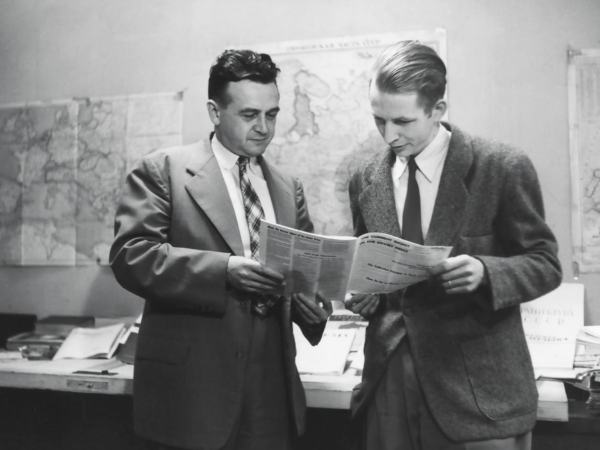
Perhaps the harshest professional penalty fell upon Philip E. Mosely, a former Russian Institute director (1951–1955) with extensive government connections. Mosely held top-secret clearances from nine federal agencies and offices. In 1954 all were revoked, largely because of his former association with the Institute of Pacific Relations (IPR), itself a major target of congressional investigations into the “loss of China.” Mosely assembled dozens of affidavits from diplomats, intelligence officers, and other prominent figures in his defense and the government restored his clearances after several months, but only after a substantial legal and reputational struggle.
During this era, Columbia did not purge the Institute or its beleaguered faculty, and its scholarly program survived the pressure campaign. But McCarthyism left a legacy of fear and revealed the central paradox of American Soviet studies in the 1950s: the country demanded expert knowledge of its principal adversary while treating the acquisition of that knowledge as inherently suspect.
Image: Philip E. Mosely (left) with Fred Stolling, associate editor of Current Digest of the Soviet Press in 1953