The Russian Institute not only wanted its graduates to engage intellectually with the Soviet Union, but to participate directly with its people and play a role in the defining events of the Cold War era. Accordingly, in 1959, the Russian Institute enabled thirteen of its graduates put their training to use as guides at the first American National Exhibition in Moscow – a U.S. government-sponsored cultural exchange program that brought Americans to the Soviet capital to exhibit U.S consumer goods and technology. The opportunity to travel to the Soviet Union and represent the United States was a significant honor, and the guides for the inaugural exhibition met with President Eisenhower before departing for Moscow. The American National Exhibition was a sensation, attracting nearly three million visitors in the six weeks between July 25 and September 4, 1959.
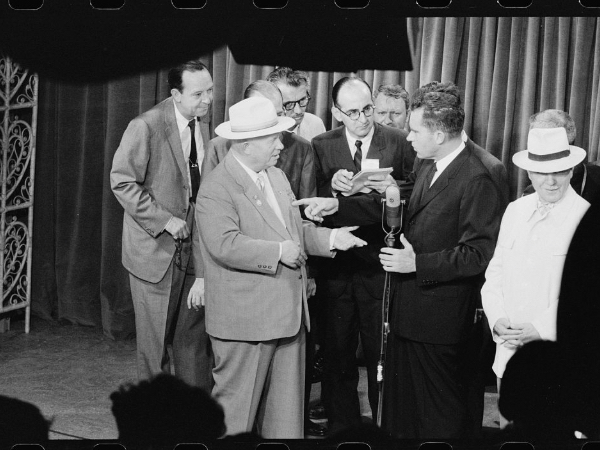
Elizabeth Krindl Valkenier (RI ’51) was one of the graduates chosen to attend the landmark exhibition. It would go down in history as one of the most iconic moments of the Cold War – the site of the famous “kitchen table debate” between Vice President Richard Nixon and Soviet Premier Nikita Krushchev. The two leaders paused before a model American kitchen – outfitted with the latest consumer goods and appliances – which became the catalyst for a bitter debate about the merits of American capitalism and Soviet communism. Valkenier was not close enough to the debate to hear it live, but, for the Harriman Institute’s Oral History Project, she recalled the accounts of her friends who were: “Nixon didn’t do so well, between you and me […] Khrushchev was very wily […] and very witty […] The exchange wasn’t dominated by Nixon, to put it mildly.”
George Feifer (RI ’61), another Russian Institute alum, was also present at the 1959 American Exhibition as a guide for the car industry exhibit. A contemporaneous New York Times article describes Feifer next to a new Ford Thunderbird with a microphone in his hand – fielding questions from a crowd of hundreds of curious Russians: “He gets five questions about his family budget for every one about the car’s horsepower.” The nature of the Russians’ questions varied dramatically. While Feifer handled many curious, well-meaning queries about American sociocultural norms, the cost of living, and the tolerance for dissident ideas in schools and society, he recalled for RadioLiberty that “skilled propagandists [were] stationed among the listeners […] to repeat questions intended to discredit me.” Their main targets were extreme economic inequality in America, the country’s aggressive military policies, and race relations between white and Black Americans. However, in spite of the organized bands of hecklers, Feifer came away from the experience with optimism: “I was learning at least as much as I was teaching.”
Timothy Frye, former director of the Harriman Institute (2009-2015), served as an American exhibition guide in the late 1980s. He described the lasting benefits of the work in his essay, “Reflections on U.S. Soft Power” for the 2026 issue of Harriman Magazine: “The exhibits produced a cadre of U.S. experts with deep knowledge of the Soviet Union and strong language skills who then went on to staff embassies, run businesses across Eurasia, and report for major news outlets.” Elizabeth Valkenier also came away from her experience as a guide energized and hopeful about the salutary effects of cross-cultural dialogue: “The exhibits not only improved my Russian language and public speaking skills, they provided a special window onto Soviet society and politics at a critical moment in world history.”