How a national tragedy spawned a non-aligned movement.
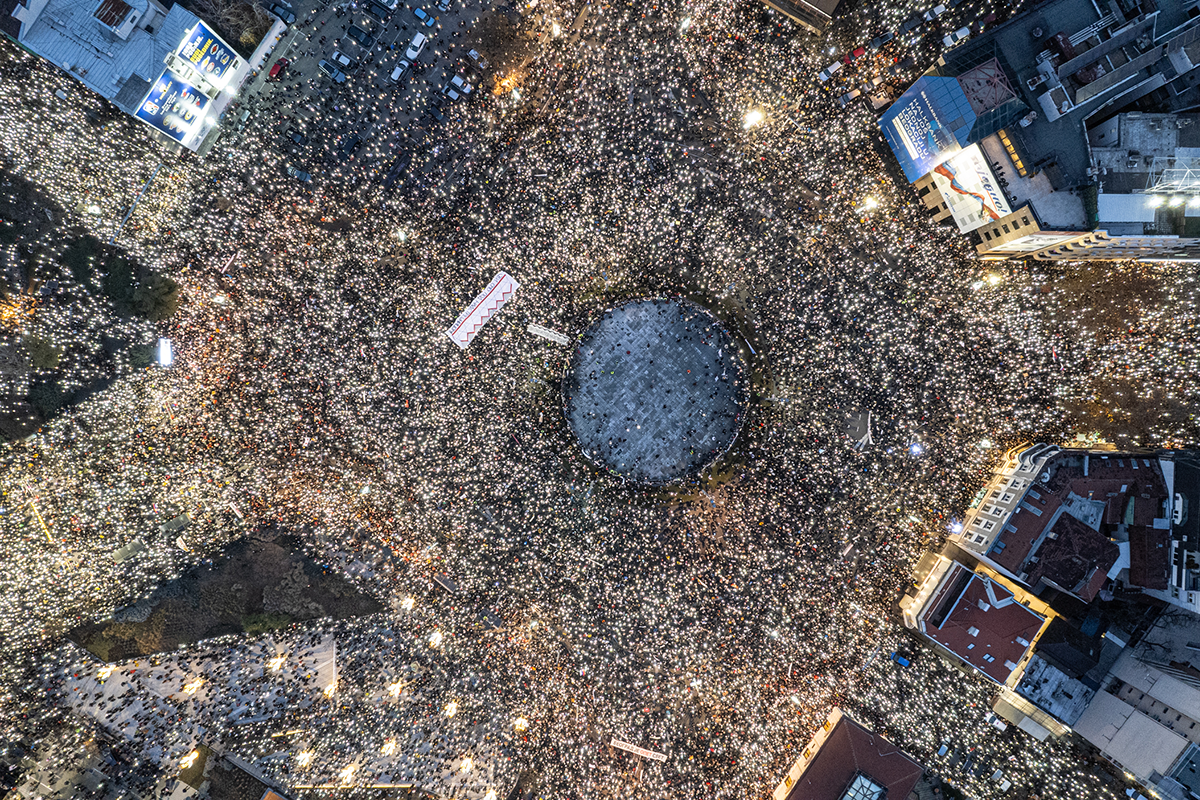
On December 22, 2024, a hundred thousand people flooded a central square in Serbia’s capital Belgrade. They stood in silence for 15 minutes before breaking into deafening noise with whistles, vuvuzelas, shouts, and drums. Then they dispersed, as calm and orderly as when they had assembled. This public demonstration likely would have seemed strange to an outsider.
The people who attended had only heard about it a couple of days earlier, when Belgrade University students announced it through their social media platforms, yet the turnout was massive. There was neither elaborate organization nor intricate logistics. And although this was a political protest, accompanied by posters displaying bloody hands and banners about corruption (“Corruption kills!” “We are all under the same canopy”), no one made a speech, no anthems were sung, and there was no stage, no microphone, no speakers to amplify any message. In fact, the only official words spoken came through a bullhorn to announce the start of the 15-minute silent vigil.
The vigil commemorated the 15 people killed on November 1, after the canopy of a newly renovated train station in Novi Sad, a city in northern Serbia, collapsed and crushed them. (A sixteenth victim passed away four months later.) The noise that followed it was an expression of rage at the fact that this tragedy was entirely avoidable. The canopy collapsed because of shoddy construction enabled by massive, deep-seated, government-facilitated corruption on all levels—from the Chinese consortium chosen as the chief contractor over an EU-based company with stricter regulations, to the many local subcontractors hired without public tenders, all the way to the country’s president, Aleksandar Vučić, who had reportedly urged that the newly renovated train station be ceremoniously opened, red ribbon and all, several months prematurely. These people died, strictly speaking, on a construction site.
Since Vučić’s advent as the country’s prime minister in 2014, institutionalized corruption routinely goes unpunished in Serbia, often involving organized crime and yielding casualties. Over the years, Vučić, now the country’s president, has fortified his grip on power largely by illegal means: by rigging elections that secured his party’s majority on all levels, enabling it to seat loyalists in every position of power; by establishing a widespread system of bribes and favoritism in the business sector; by relentlessly weakening the political opposition; and by extinguishing all but a few independent print and electronic media outlets. On the diplomatic front, Vučić’s government has been giving ample incentives to foreign direct investment, including subsidies and tax benefits, which bring capital into the country and enable the government to offer contracts and subcontracts to loyal domestic partners, some of whom are involved in organized crime. (Robert W. Worth’s 2023 New York Times excellent exposé, “The President, the Soccer Hooligans and an Underworld ‘House of Horrors,'” details the dense interdependence of Vučić’s government and criminal groups.)
In the context of this vicious circle of domestic corruption, foreign inflow, and organized crime, bodies buried under the rubble of a shoddily built train station canopy are far from shocking.
But in its brutality and brazenness, the canopy collapse was the last straw. It crystalized the regime’s negligence and criminality, rendering it impossible to ignore. When no government official took responsibility, anger that had simmered for years exploded into a movement.
For the first eight months this movement was student-led. In late June of 2025, during another mass gathering in Belgrade, students gave citizens a “green light” to enter the fight more robustly, urging them to make the struggle their own, to demand snap elections, and to self-organize. Students did this because they felt that the fight must become a wholesale social uprising. The green light marked a turning point: Since July 2025, when thousands of citizens began protesting by blocking highways and intersections, the government’s response, until then largely restrained, became openly hostile and excessively violent. The crackdown was so fierce that even some mainstream Western media and a few European Union parliamentarians, who had been glaringly silent, began voicing their concerns.
The Serbian protests began as small student-led vigils, fueled by collective mourning, eventually growing into a nationwide uprising, one that shares many features with other recent popular movements (in Georgia and Greece, for example, or more recently in Indonesia or Nepal). Yet the Serbian example is unusual in its having managed, so far, to avoid one of the common pitfalls that plagues most long-lasting mass protests—fragmentation that leads to internal strife and the eventual dissolution of a movement. This movement’s strength lies in the tactics that frame it: in these protests, students are a leaderless collective without a command center or identifiable political ideology, unified only by mourning for the 16 victims and a demand for justice. Because the core of this approach is the students’ insistence on justice and their refusal to take any ideological side, one could call their strategy “non-aligned” and understand that as the key to the protests’s endurance: non-alignment as the canopy under which disparate orientations coexist. Given Serbia’s historical involvement in the Non-Aligned Movement of the Cold War era, the crux of which was precisely the rejection of its member states’ ideological alignment, it is notable that the current student movement in Serbia draws its power, even if inadvertently, from this repressed political tradition.
◆◆◆
In the immediate aftermath of the canopy collapse, Serbian authorities began to spin various excuses for the tragedy, while opposition parties and non-governmental organizations called on citizens to demand justice for the dead. They gathered in large groups in front of ministries, courts, and the ruling party’s offices where they threw red paint and hoisted banners with red handprints. And they assembled at crosswalks and major intersections to stand in silence as a sign of respect for the victims of the train station tragedy. University students soon joined in, and by the last week of November, following a violent incident when officials from Vučić’s ruling party attempted to break up a student traffic blockade, the students moved the protest to the next phase. They blockaded and occupied their university buildings, moving into the university premises and banning anyone without a valid student ID from entering (Serbian universities have strong autonomy: police can enter the campus only in an emergency or at the dean’s explicit invitation). Then they called on professors to join them in suspending classes, exams, and all curricular and extracurricular activities, which most professors did. Within weeks all state universities followed suit: they began a general strike and put forth four demands to the government. The first called for making public full documentation of the railway station’s renovation, with the aim of forcing the Prosecutor’s Office to file criminal charges in the canopy case against the responsible government officials.
From this point on, the protests became student led. Students organized working groups and volunteers to communicate with university administrations, maintain order at large gatherings, and collect non-monetary donations from citizens. They appropriated the red hand as their symbol and put in place a well-coordinated network of social media accounts (#studentiublokadi / #studentsinblockade) where they posted statements that announced activities. The posts were catchy, timely, short, and shareable. They aimed to ridicule the authorities while keeping the focus on the canopy tragedy and its victims. The combination was effective: humor eroded citizens’ fear of the government while grief mobilized them to join the protests. Students also staged surprise events, planned in secret and announced just prior to their commencement, a strategy that kept the authorities in a reactive mode. One such action was the surprise “occupation” of the state-controlled national television building in March 2025. Students and other protestors camped at the building’s entrance for several days; at 7:30 each night, during the live daily news broadcast, which routinely ignored the protests, the campers made a deafening noise that could be heard by those watching the news at home.
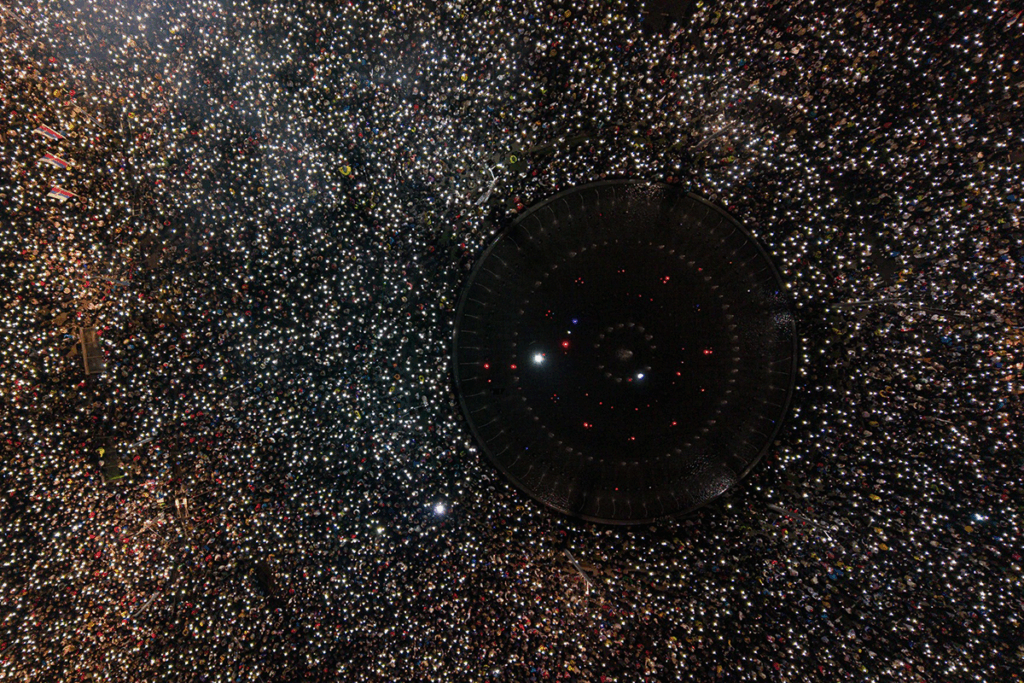
Drone image of a protest at Slavija Square in Belgrade. December 22, 2024. Photo courtesy of the Public Assemblies Archive
Collective marches were also effective. In Serbia, the ruling party controls most media and denies national coverage to opposition-leaning broadcasters. To overcome this censorship, groups of dozens to several hundred students walked from one university city to another, stopping along the way in rural areas where they met with residents and talked with them about the protests and their demands. In addition to bypassing media control, marches and face-to-face communication were a way to reach people who don’t typically use social media—particularly older generations and rural dwellers. The marches took on international form in April and May when students cycled more than 700 miles, from Belgrade to Strasbourg, France (they called it the “Tour de Strasbourg”), and ran a 1,000-mile relay marathon to Brussels, Belgium to disseminate information about their protests and demands to European institutions.
Everything the students did—and, as of this writing in October 2025, were still doing—was impersonal. They never targeted specific government officials, nor did their movement revolve around a specific leader. Starting from their first demand—to make the renovation details public—students focused on the law, impersonal by design, as the primary instrument of accountability. To that end, they have declined repeated invitations from Vučić to meet and negotiate with the government: the president and his ministers, the students argued, were “unauthorized” to resolve the crisis. In their view, if Serbia were truly governed by the rule of law, as the government insists, negotiations about legal accountability would not only be unnecessary but also unconstitutional. By articulating the first demand in strictly legalistic and impersonal terms, the students revealed the government’s supposed devotion to fundamental democratic values, such as transparency and accountability, to be purely demagogic. They have also fashioned themselves as the impersonal bullhorn of the law. They have no leaders, spokespersons, or representatives; their announcements are anonymous, signed only “Students in the Blockade,” and every time they talk to the media a new person does the talking. Apart from the red handprint, they have no signs or slogans that would associate them with any political camp. Except for Serbian and university flags, no other flags are allowed at their gatherings: They accept all ideologies but refuse any identifiable markers and alignments. The effect of this insistence on legalism, impersonality, and non-alignment is disorienting for a system like Serbia’s, where the government maintains power and defends itself from dissenters by defaming and intimidating them personally, or by labeling them as pro-Western agents paid by outside powers to destroy the country. When faced with an anonymous, diffuse mass, the government can’t mount focused retaliation.
At the root of the students’ insistence on non-alignment and nonpartisanship lie plenums—meetings where students discuss strategies and plan actions agreed to by majority vote. Every school within the university holds its own plenums, open only to students enrolled in it. Deliberations about major actions, such as one in January 2025, where students blocked Belgrade’s major traffic artery for 24 hours and brought the city to a standstill, can go on for days as students need the majority vote of nearly 50 schools and their plenums. (A few months into the protests, citizens took plenums as the model for their own self-organizing and began holding municipal civic assemblies where they gathered to consider a local issue and vote on it. The effectiveness of these public assemblies lies in their capacity to further mobilize citizens for political action.)
Structurally, plenums are modeled on the decision-making platforms of workers’ councils in socialist Yugoslavia, which Serbia was part of until the 1990s. The councils promoted self-governance and decentralization. The plenums’ intellectual lineage can be traced to a tradition that developed around the same time—namely, the Marxist philosophical school known as the Praxis Group, which in the former Yugoslavia of the 1960s–70s advocated for worker self-management to administer and oversee all institutions of the state, cultural as well as political (and, as Marx had projected, after the dictatorship of the proletariat to dissolve the state itself). For Serbian students today, much like for the workers in socialist Yugoslavia, representative democracy appears susceptible to the same kind of systemic corruption that caused the canopy collapse. To preempt it, they have recovered the suppressed participatory format of decentralized self-governance—direct democracy—where non-alignment, through the vote and participation of everyone regardless of their ideological allegiance, is the defining framework.
This framework is inseparable from the political phenomenon of the Non-Aligned Movement, an organization founded by socialist Yugoslavia, a rare European communist country that didn’t belong to the Eastern bloc. Established in 1961 in Serbia’s (then Yugoslavia’s) capital Belgrade, the movement aimed to sidestep the global East/West divide of the Cold War. Within the Movement’s paradigm, being non-aligned doesn’t mean being ideologically neutral but rather not being aligned along the usual fault lines: progressive/conservative, liberal/authoritarian, etc. The fact that in 2025 Serbian students, who have been raised on ideas of national division and religious intolerance inherited from the Yugoslav wars of the 1990s, have found a framework for their struggle in a forgotten and historically vilified political tradition, may very well explain the protest’s endurance. It has enabled the movement to attract diverse demographics: citizens across all social, political, and cultural divides—workers, farmers, and professionals; leftists, greens, antifascists, and anarchists; as well as nationalists, conservatives, constitutionalists, and monarchists brought together to support the same set of demands.
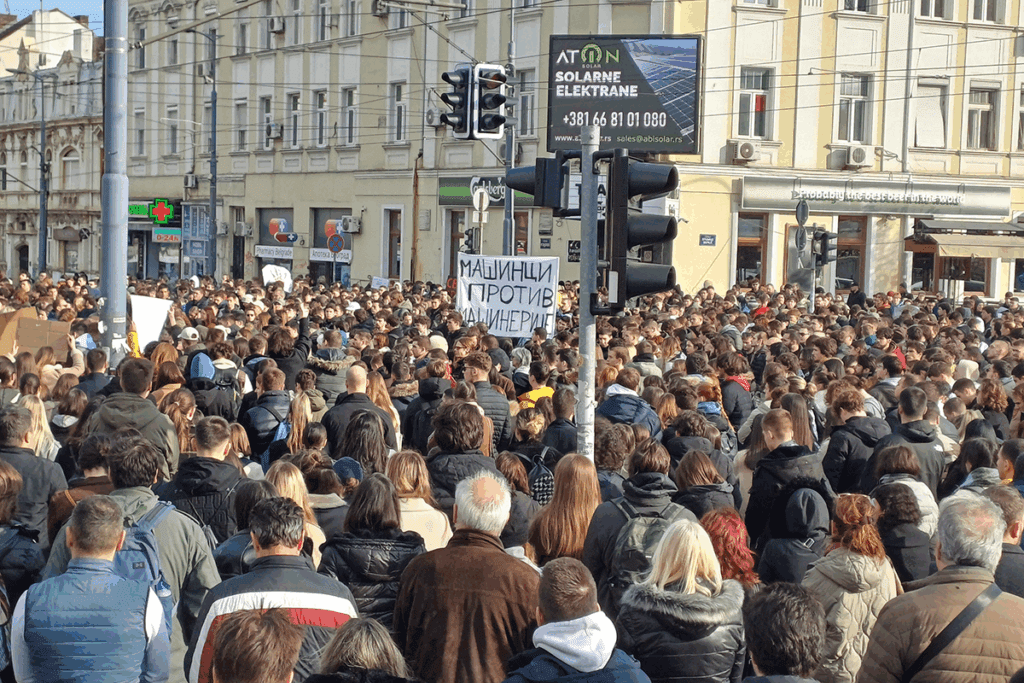
Silent vigil at one of the large intersections in downtown Belgrade, following which vigil-blockades were held every day at 11:52 am. December 6, 2024. Photo courtesy of the Public Assemblies Archive
The three pillars of Serbia’s uprising—the impersonality of the student body, the legalistic nature of their demands, and the protest’s ideological non-alignment—stem from a common source: collective grief. This is why the public vigils are the protests’ primary format. Until June 2025, when the students transferred the protest leadership to society at large and the protest became more aggressive, peaceful public vigils took place every day at 11:52 a.m., the time the canopy had collapsed the previous November. Crosswalks and intersections in towns across the country were occupied, blocking traffic for 16 minutes and bringing whole neighborhoods to a stand-still. These blockades can feel oppressive because of the silent sadness that envelops them, yet liberating because each participant shares this burden with many others. For 16 minutes—a long time to stay still with a single thought—grief lingers, amplified by the silence through which, even in a bustling capital like Belgrade, one can hear birds, wind, and distant shouts. In this stillness attention turns from the bodies under the canopy rubble to one’s own losses—then back to the canopy, back to anger, and back once again to grief. The circle of sadness and anger feeds on itself as impersonal losses become one’s own, and one’s own losses—everyone else’s. There is no room for ideological alignment.
And yet, if the non-aligned approach is internally unifying, it is also confusing to an international audience and may explain why both the European Union and most Western media have been silent about the situation in Serbia. To remain non-aligned, students have refrained from taking a position on any domestic or foreign policy issue. It is therefore unclear whether, if the protests topple the current government in Serbia and students manage to win future elections, the new government will be pro-Western or pro-Kremlin. And because Serbia is historically close to Russia yet remains an official and viable candidate for EU membership, its geographic position (it borders several EU members) makes the question of its political alignment especially urgent in the context of the war in Ukraine, the EU’s sanctions against Russia, and the United States’ distancing from NATO and European defense alliance. The EU does not want a potential Russian outpost in its midst, and so it tends to favor what is often referred to as “stabilocracy”—stability over democracy. In addition to these geopolitical reasons, the West is reluctant to criticize Vučić’s government because some Western governments as well as their countries have active and lucrative infrastructure deals, long-term investments, and weapons sales contracts with it. But above all, the West wants a guarantee that Serbia’s large lithium reserves (the metal used to produce batteries in electric vehicles) will be made available to European countries for extraction.
Most protesters see the lifeline that the West has given to the current Serbian regime as a crude colonial stance that tolerates autocracy in exchange for resources and capital.
◆◆◆
Analyzing an ongoing popular uprising is as difficult as attempting to understand trauma while it is still unfolding. But however they end, the protests in Serbia have foregrounded some of the key aspects of the idea of non-alignment and offered them as possible (and, in a deeply divided society, likely the only viable) strategy for engendering a massive rebellion to replace autocracy with a civil society grounded in the rule of law. By emphasizing the legalism; by turning citizenry into an anonymous multiplicity that cannot be easily broken; by reverting to rudimentary forms of information dissemination; and by deploying mass blockades to paralyze corrupt institutions, Serbia’s student movement has laid a foundation for meaningful change on all levels. It is up to the citizens now to build on it.◆
I am grateful to Branka Arsić, Aleksandar Bošković, Marija Džambić, Aleksandar Gubaš, Kir Kuiken, and Obrad Savić for their comments, suggestions, and fact-checking.
Vesna Kuiken is a Lecturer at the University at Albany, SUNY. She specializes in nineteenth-century American literature and ecocriticism.
Featured photo: Drone image of a protest at Slavija Square in Belgrade. December 22, 2024. Photo courtesy of the Public Assemblies Archive